Manufacturers can create several usable outputs from a single production run. When those outputs share components, labour, and work-centre costs, finance teams need a consistent way to determine how much production cost remains with the main finished good and how much is allocated to each by-product.
For example, a process may produce lumber and sawdust, fabricated parts and saleable metal offcuts, or cheese and whey. Odoo 20 provides a Cost Share field on the Bill of Materials (BoM) to allocate a defined portion of manufacturing cost to planned by-products.
Identify Planned By-Products Before Allocating Cost
In Odoo, by-products are planned secondary outputs recorded on the same BoM as the main finished product. They should represent expected, measurable outputs with a defined business use, such as resale or internal consumption.
Scrap and inventory adjustments serve different purposes. Scrap records unusable material, while inventory adjustments correct stock discrepancies. Keeping these transactions separate helps maintain reliable production and cost records. For more details on configuring and managing planned by-products, refer to the Odoo 20 By-Products documentation.
How Cost Share Distributes Manufacturing Costs
Odoo 20 uses the Cost Share (%) field on the By-products tab of a BoM to allocate a portion of the final manufacturing cost to each planned by-product. The combined Cost Share percentages for all by-products cannot exceed 100%. The remaining production cost is assigned to the main finished product. For additional information about BoM configuration, see the Odoo 20 Bill of Materials documentation.
Cost Share defines how production cost is distributed across outputs. It does not set a selling price or establish market value, revenue, margin, or profit. A lower cost assigned to the main product may simply mean that more shared production cost has been allocated to secondary outputs.
How to Choose a Cost Share Percentage
Manufacturers should choose a Cost Share method that reflects the economic relationship between the main product and its by-products. Three common approaches can support this decision:
- Physical quantities: Allocate costs based on the relative quantities or weight of each output. This can work when products have similar economic value per unit.
- Relative sales value: Allocate costs according to each output's share of the total sales value at the point of separation. This is useful when the main product and by-products have different market values.
- Net realizable value (NRV): Use the estimated sales value of each output less any additional processing and selling costs required to make it saleable. This can be more appropriate when by-products need further processing before sale.
The selected method should reflect the production process, available data, and the company's costing policy. Apply it consistently and document the assumptions behind the assigned Cost Share percentages.
A Controlled Cost Share Comparison
The following hypothetical example isolates the effect of changing the Cost Share percentage. It illustrates production cost allocation, not a guaranteed inventory valuation result for every Odoo configuration.
Assumptions: one manufacturing order produces 10
units of the main finished good and 2 units of one usable by-product. Total
final manufacturing cost is CAD 10,000. Both scenarios use the same quantities,
components, work-centre costs, currency, and rounding approach.
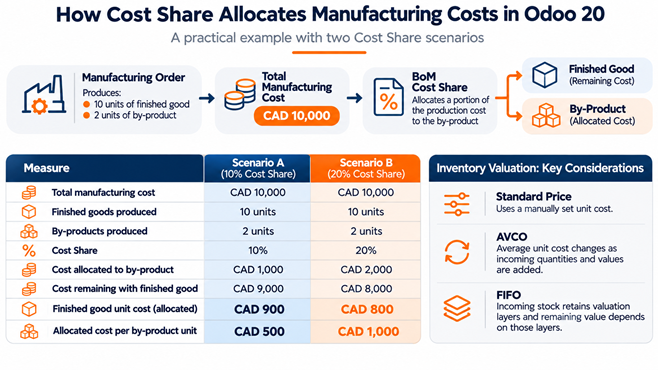
The example shows how the Cost Share percentage splits the manufacturing cost between the finished good and the by-product. The allocated amounts (CAD 500 and CAD 1,000) are production cost allocations, not confirmed inventory values under Standard Price, AVCO, or FIFO.
In Scenario A, 10% of CAD 10,000, or CAD 1,000, is allocated to the by-product. Across two units, this represents CAD 500 of allocated production cost per unit. The main finished good retains CAD 9,000, or CAD 900 per unit across ten units.
In Scenario B, 20% of CAD 10,000, or CAD 2,000, is allocated to the by-product. This represents CAD 1,000 of allocated production cost per by-product unit. The main finished good retains CAD 8,000, or CAD 800 per unit.
The comparison shows the direct effect of Cost Share on the allocation of manufacturing cost. The per-unit by-product amounts above are allocated production costs; they should not be described as confirmed stock values until the resulting inventory valuation has been reviewed under the product's configured costing method.
Understand the Difference Between Cost Allocation and Inventory Valuation
Cost Share and inventory valuation are related, but they answer different questions. Cost Share determines how manufacturing cost is allocated across the outputs of a manufacturing order. The inventory costing method determines how incoming and outgoing stock movements are valued.
Odoo 20 supports three inventory cost methods. Their general behaviour is:
- Standard Price: the product's unit cost is maintained manually. Inventory movements are valued using that standard cost; the product cost is not automatically recalculated by each movement.
- Average Cost (AVCO): the unit cost is based on the weighted average value and quantity on hand. Incoming stock can change the average cost.
- First In, First Out (FIFO): incoming quantities retain valuation layers. Outgoing movements consume the oldest available layers first.
These methods affect how stock value is maintained, but their general definitions do not establish the exact valuation outcome for every manufactured by-product and configuration. Do not assume that the allocated cost per by-product unit in the example will always appear as the final unit cost or stock value under Standard Price, AVCO, or FIFO.
To interpret a completed production correctly, review the Manufacturing Order cost, the finished-product and by-product stock moves, the product's costing method and cost field, and the Inventory Valuation records. The available accounting entries also depend on the inventory valuation configuration and installed Accounting functionality.
Review Production and Finance Records Together
The completed Manufacturing Order shows the production transaction and its cost information. Product Moves show the quantities moved into stock, while Inventory Valuation provides the corresponding stock-value information where the relevant valuation setup is enabled. Reviewing these records together helps distinguish the manufacturing allocation from the value carried in inventory.
Odoo 20's Production Analysis includes the By-Products Total Cost measure, which shows the production cost assigned to by-products on manufacturing orders. For more information about manufacturing performance analysis, refer to the [Odoo 20 Production Analysis documentation].
Comparing allocated cost with selling price, recovery rate, disposal expenses, or realized margin may require additional Inventory and Accounting reporting, exported data, configuration, or tailored reporting.
Set a Consistent Cost Share Policy
A documented Cost Share policy gives production, finance, and commercial teams a shared basis for evaluating joint outputs. Set percentages according to the organization's costing methodology and review them when production conditions, output quantities, or the commercial use of by-products change. Cost allocation can also inform make-versus-buy decisions. For a broader comparison of in-house production and outsourcing, see our article Make vs. Buy Analysis in Manufacturing: How to Choose Between In-House Production and Outsourcing.
When assessing product margins or make-versus-buy decisions, keep three figures distinct: the manufacturing cost allocated to each output, the inventory value recorded under the selected costing method, and the revenue or recovery value realized when a by-product is used or sold.
Improve Cost Visibility for Every Output
KoderShop helps manufacturers align Odoo workflows with the financial and operational realities of manufacturing by-products. Our team can assess where standard functionality fits and identify configuration, integration, or custom reporting needs. Contact KoderShop to discuss your production costing requirements.