Odoo 20 Manufacturing allows companies to document both in-house production and subcontracting options for the same product. A manufacturer can maintain a standard manufacturing Bill of Materials (BoM) with its components and operations, as well as a subcontracting BoM with the external supplier and required components. This gives the team a consistent product record for reviewing internal production costs alongside supplier pricing and subcontracting requirements.
In-house manufacturing means using your own people, materials, work centres, equipment, and quality processes to produce a component or finished item. Outsourced manufacturing means asking a qualified supplier or subcontractor to make that item to your specifications. We recommend comparing both financial and operational factors before choosing either path.
Compare Full Costs Across in-House and Outsourced Work
A supplier quote can look simple, while internal production costs can appear scattered across purchasing, labour, maintenance, and production records. For a useful make-or-buy decision, we need to bring comparable costs into the same view.
In-house manufacturing costs may include:
- Purchased components and raw materials
- Direct labour, work centre time, tooling, maintenance, and utilities
- Quality checks, scrap, rework, supervision, and machine setup
- Facility overhead, administration, financing, packaging, shipping, and compliance costs
The subcontractor's quoted price may cover materials, labour, equipment, and the supplier's overhead, depending on the agreement. The buyer should check exactly what the quotation includes and add any costs that remain with the company, such as inbound freight, receiving and inspection, inventory carrying costs, engineering changes, supplier onboarding, expediting, customs charges, and quality-related expenses. For a valid comparison, the internal production cost and subcontractor price must cover the same product specification, quantity, quality requirements, and delivery scope.
Odoo 20 distinguishes between the estimated MO Cost and the Real Cost of a Manufacturing Order. Both calculations include component costs and manufacturing operations. The estimated MO Cost uses the component quantities and costs defined on the BoM, planned operation durations, work centre operating rates, and configured employee cost rates. The Real Cost reflects actual component consumption, recorded work order durations, and the hourly costs of the employees who performed the operations. After the MO is completed, Odoo updates the MO Cost to match the Real Cost.
These figures provide a detailed view of the costs recorded for in-house production, but they do not automatically represent the manufacturer's full business cost. Facility expenses that are not included in work centre rates, administration, financing, outbound freight, packaging, and other indirect expenses may need separate allocation. Managers should identify which costs are already included in Odoo before adding them to the comparison, to avoid double-counting.
Weigh Capacity, Risk, and Control Before Selecting a Source
Unit cost matters, but it rarely decides the issue on its own. An internally made part may cost more in production records while protecting delivery dates when an outside supplier has a long or unpredictable lead time. On the other hand, outsourcing may prevent a constrained work centre from delaying a higher-priority order.
Before selecting a source, we suggest reviewing:
- Available capacity and utilization at constrained work centres
- Labour availability, setup time, equipment capability, and technical expertise
- Supplier quality systems, lead-time reliability, and response to engineering changes
- Intellectual property, traceability, process knowledge, and revision control
- Single-source exposure, border delays, currency changes, and supplier stability
Producing internally can give you closer control over tolerances, production methods, and product revisions. Outsourced manufacturing can provide access to specialized machines, certifications, or processes that would be expensive to build internally.
For many manufacturers, a hybrid model is practical. You may keep critical, variable-volume, or proprietary work in-house while outsourcing stable-volume or highly specialized processes. This approach can preserve internal knowledge while adding external capacity when demand changes.
Use ERP Data for a Make-or-Buy Decision
An ERP system can organize the production and purchasing information needed for a documented comparison. It does not automatically choose the better source or generate a complete make-or-buy recommendation. Management still needs to define the cost categories, operational risks, and strategic requirements that matter to the business.
For the in-house option, maintain a Manufacturing Bill of Materials for the product, with its required components and operations. Applicable work centres and operation costs can support estimated production costing. Production records can then provide estimated and actual cost information. Planned operation durations support the estimate, while actual recorded durations can change the final production cost. Labour costs are included in the manufacturing cost calculation through employee hourly rates. For the estimated MO Cost, Odoo uses the per-employee rate configured on the Work Centre. The Real Cost uses the Hourly Cost recorded on each employee's profile for the employees who performed the work.
For outsourced production, Odoo 20 supports subcontracting through a dedicated subcontracting BoM and a vendor record for the subcontractor. When the company supplies the components, the workflow starts with a Purchase Order for the subcontracted product. After the PO is confirmed, Odoo automatically creates a resupply transfer for sending the components to the subcontractor and a receipt for the finished product.This allows purchasing and inventory teams to track the subcontracting charge, company-provided materials, and the movement of components and finished goods.
In a resupply subcontracting arrangement, the company sends its own components to the subcontractor. Odoo 20 records this through the Resupply transfer generated from the subcontractor's purchase order. After production, the company validates the receipt of the finished product. For the make-or-buy comparison, include the value of supplied components, the subcontracting service charge, resupply freight, handling, and any additional inspection costs.
- Comparison Area | In-House Production | Subcontracted Production
- ERP-recorded costs | Components, planned or actual operations, work centre and configured labour costs | Supplier pricing, subcontracting purchase details, related inventory movements
- Supplier-provided pricing | Not applicable | Subcontractor quote or vendor price
- Operational lead time | Work centre capacity, labour, setup, and production schedule | Supplier lead time, resupply timing, freight, and receiving
- Management-only considerations | Facility overhead, administration, shipping, compliance, financing | Freight, inspection, customs, quality risk, supplier resilience, supplied component value
Odoo 20 includes standard Landed Costs functionality for allocating eligible additional expenses, such as freight and customs duties, to inventory valuation. The feature requires configuration and supports products using FIFO or AVCO costing. Custom dashboards, approval workflows, and automated make-or-buy comparison reports may require additional configuration, integration, or tailored development.
Test the Choice with a Canadian Metal Component
Consider a hypothetical Canadian manufacturer that needs 1,000 identical metal mounting components. Both sourcing options must meet the same material grade, tolerances, quality standards, and delivery requirements. The figures below are illustrative and are not industry benchmarks.
Compare the Estimated and Actual In-House Costs
For in-house production, Odoo manufacturing data may show an estimated cost of CAD 38.00 per unit, based on the following components:
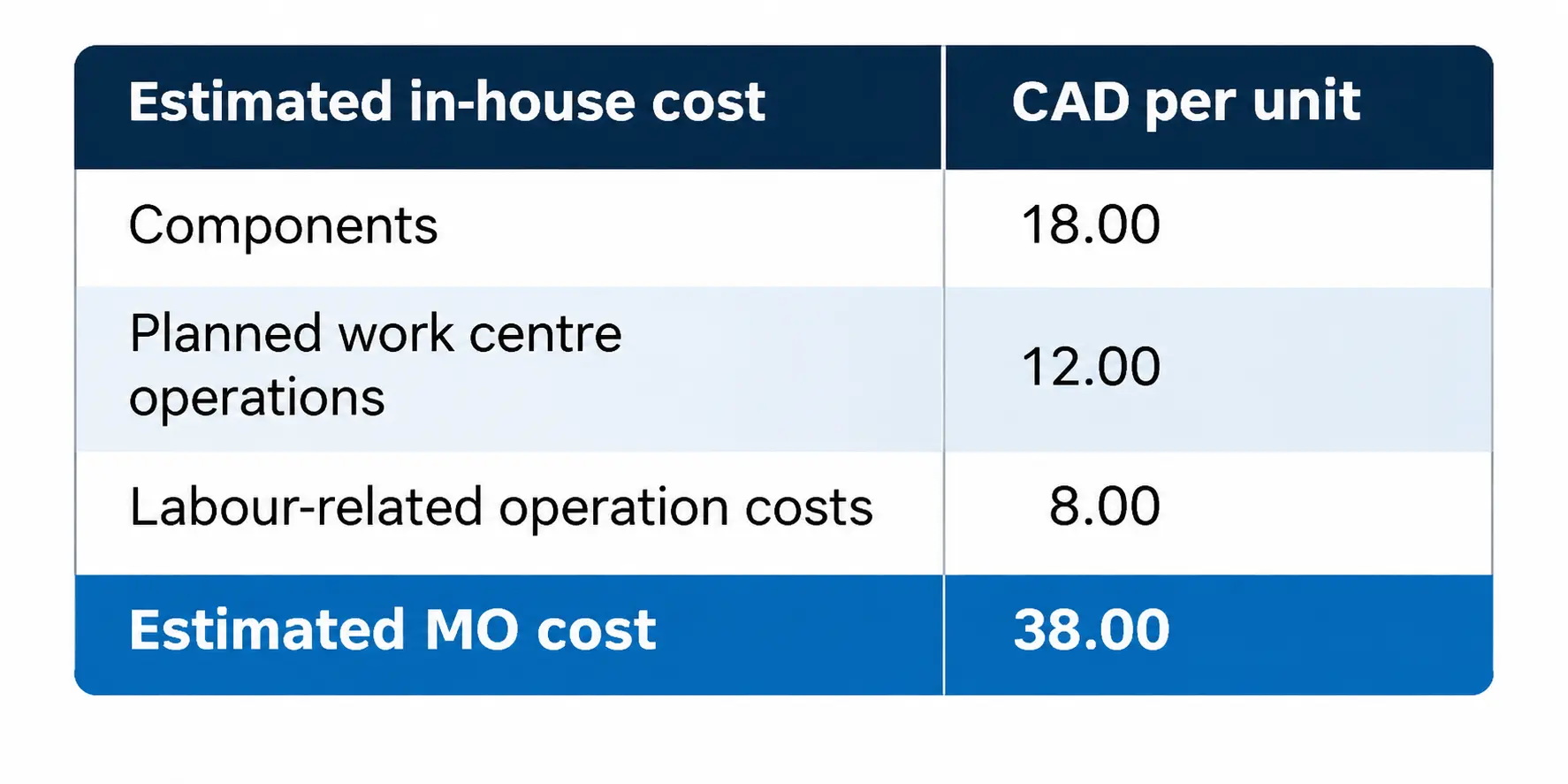
Actual production could reach CAD 40.50 per unit because of higher component consumption and longer recorded operation times. Management may also need to account for additional business expenses that are not included in the recorded manufacturing cost.
Compare the Full In-House and Subcontracting Costs
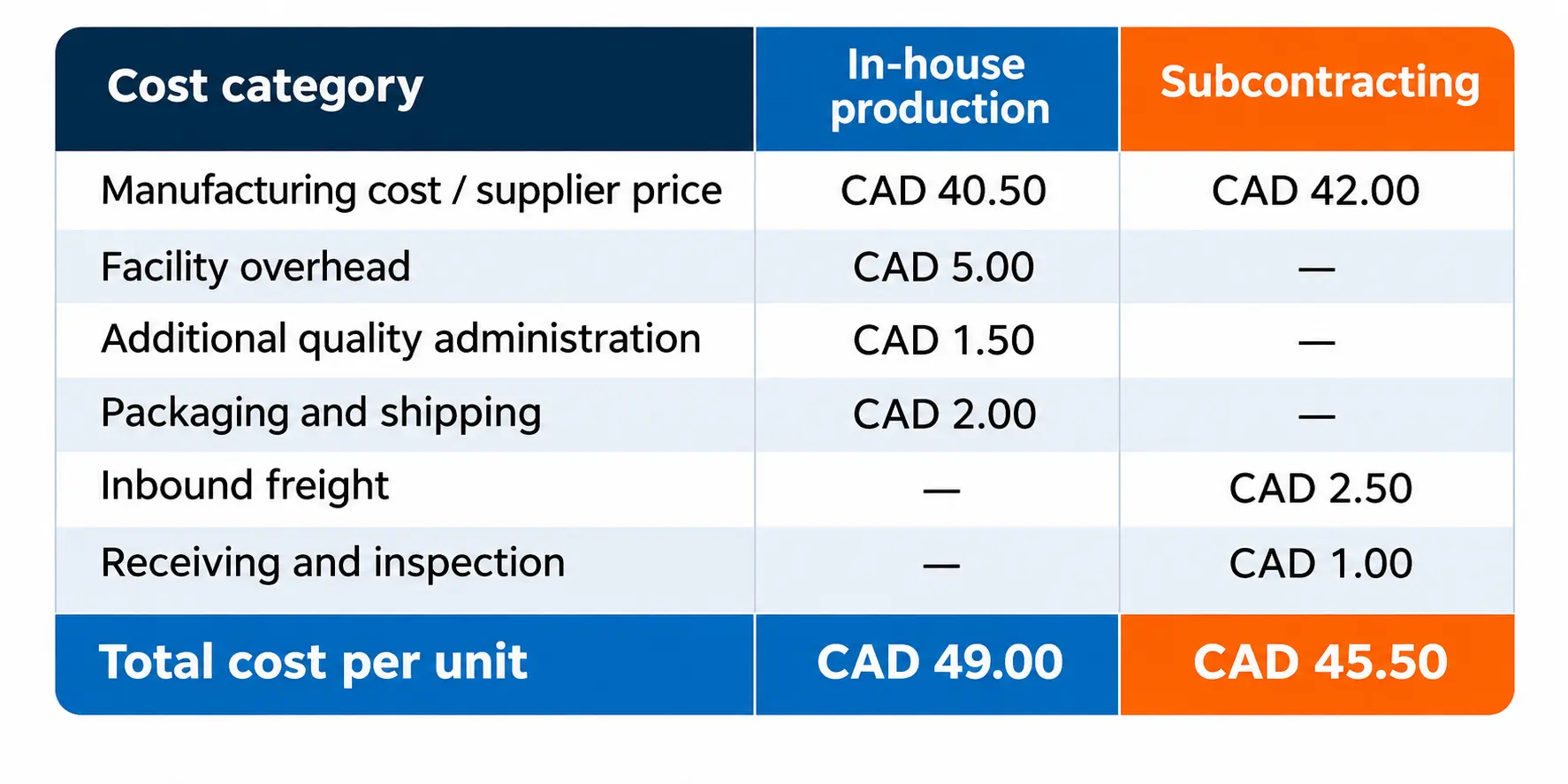
The in-house figure includes the actual production cost and the additional internal expenses listed above. The subcontracting figure includes the supplier's quoted price, inbound freight, and receiving and inspection.
Based on these illustrative figures, subcontracting costs CAD 3.50 less per unit. For 1,000 components, the difference would be CAD 3,500, provided both options cover equivalent specifications, quality requirements, and delivery scope.
The comparison must also account for any costs missing from either side. For example, the supplier's quotation may exclude packaging, special testing, customs charges, or engineering changes. Internal production may involve additional costs that have not been allocated to the manufacturing order.
In this example, the manufacturer supplies the raw metal to the subcontractor through a resupply arrangement. The value of the supplied material must therefore be included in the subcontracting cost, alongside the subcontractor's processing charge and any additional logistics or handling expenses.
Account for Company-Supplied Materials
If the manufacturer supplies components to the subcontractor through a resupply arrangement, their value must remain part of the subcontracting cost. The comparison should include the supplied materials, subcontracting service charge, resupply freight, handling, and any additional inspection costs.
Odoo 20 can record the subcontracting purchase, component resupply, and receipt of the finished product. Management should use these records alongside any additional cost allocations needed to compare both sourcing options on an equivalent basis.
The figures help illustrate the financial comparison, while the final sourcing decision should also consider available capacity, supplier reliability, lead times, quality requirements, and the strategic importance of keeping production in-house.
Reassess Sourcing Choices Regularly
A practical make vs. buy analysis comes back to four questions: Is the fully scoped cost competitive? Is internal capacity available without affecting higher-priority work? Can quality, lead time, and intellectual-property controls be maintained? Is the supplier reliable enough for the item’s business importance?
In-house manufacturing may suit strategic components, proprietary processes, variable demand, or available internal capacity. Outsourcing may fit specialized work, capacity constraints, lower-volume requirements, or situations where new equipment investment is difficult to justify. We recommend reviewing the decision as labour rates, supplier pricing, exchange rates, demand, equipment utilization, and delivery requirements change. ERP data can help you monitor production costs, subcontractor pricing, component usage, lead times, and operational performance over time.
Turn Cost Data Into Confident Sourcing Decisions
Our team helps manufacturers configure Odoo 20 manufacturing orders to capture the operational and financial data behind each sourcing decision. Kodershop can align production, purchasing, subcontracting, and reporting workflows with the way your business evaluates cost, capacity, and delivery performance. To discuss your requirements and identify practical next steps, contact us.