TL;DR
- Changes start on the floor too. A workaround, a substitute part or a new assembly trick changes the product as much as a drawing revision does.
- Unlogged changes come back late. They tend to resurface as scrap, a customer complaint or a recall, long after anyone remembers why they were made.
- Tariffs are adding to the pile. Half of Canadian manufacturers buying from the US planned to find suppliers elsewhere, and every swap is a possible engineering change.
- The fix is a route in. Make proposing a change quicker than working around the process, and make sure someone answers.
During the Cybertruck's first months of production, workers at Tesla's factory near Austin began using soap to help fit a rubber pad onto the accelerator pedal. It made a fiddly job easier, and engineering never signed off on it. The soap residue meant the pad could slip off and trap the pedal down. In April 2024, the US regulator NHTSA traced the problem to what it called "an unapproved change", and the recall covered every one of the 3,878 trucks built up to that point.
I chose this case because the change behind it was tiny and well-meant, which is what most shop floor changes look like. This month our theme is engineering and product control. Last week we looked at keeping BoM versions accurate. This week we're looking at engineering changes from the other end: the ones that start on the floor and never reach engineering at all.
What Counts as an Engineering Change?
An engineering change is any change to what goes into a product or how it gets put together: a component, a tolerance, a material, a tool or a process step.
Most manufacturers have a process for changes that start in engineering. Someone raises a request, it gets reviewed and approved, and a new BoM or routing goes out to the floor. The soap case raises a different question, which is what happens to changes that start somewhere else. A lubricant added to ease assembly is a process change. So is a lower torque setting because the old one kept stripping threads, a shim added because parts from a new batch don't seat properly, or a different fastener because the usual one ran out. Each of these changes the product. Product control comes down to one thing: the product you've documented and the product you're building stay the same, and that only holds if changes from every direction end up in the same place.
Why Do Shop Floor Changes Go Unrecorded?
Usually because recording a change is harder than making it, and nobody on the floor thinks of a workaround as an engineering change.
There are three common reasons. The change feels too small to bother anyone with. Solving problems is the job, so an operator who keeps the line moving with a quick fix is doing exactly what they get praised for. And there's often no easy way in. If proposing a change means emailing an engineer who's three projects behind, the workaround wins every time.
So if your best operator found a better way to do a job tomorrow, where would it get written down?
Unrecorded changes don't disappear. They come back as scrap nobody can explain, quality that drifts after a shift change or, in the worst case, a recall. By then the person who made the change may have moved on or retired and taken the reasoning with them. That's the same problem we looked at in October with maintenance knowledge and the skilled trades retirement wave.
Here's how the two routes compare.
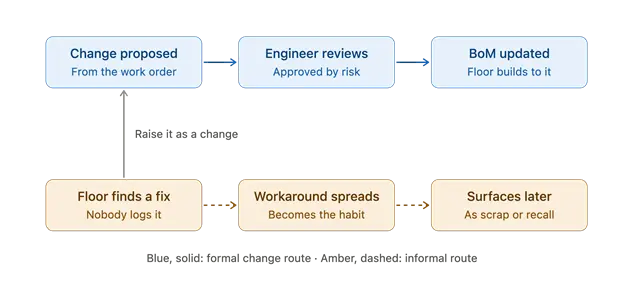
Most change processes are missing that single upward connector. Without it, the bottom lane runs on its own until something forces it into view.
How are Tariffs Creating More Engineering Changes in Canada?
They're forcing supplier swaps faster than most change processes were built to handle.
Statistics Canada's business conditions survey for the third quarter of 2025 found that among Canadian manufacturers importing from the US:
- 91.3% planned to take some action in response to tariffs over the following 12 months
- 50.0% planned to look for alternative suppliers outside the United States
Each of those swaps is a possible engineering change. A bracket from a new supplier can match the same drawing and still behave differently on the line. The finish might be slightly different, a coating might take paint differently, or the tolerances might sit at the other end of the allowed range. In many shops, though, a supplier change gets treated as a purchasing decision. The purchase order changes, the part arrives and the floor works out the differences.
That's the soap case again in a more ordinary form. With tariff conditions still shifting through 2026, some shops will swap the same part more than once, and each round adds another change engineering may not know about.
How Do You Give the Shop Floor a Route Into the Change Process?
Make proposing a change quicker than working around it, and make sure every proposal gets an answer.
- Propose from where the work happens. An operator should be able to raise a change from the work order they're on, without switching systems or writing an email. In Odoo, for example, an operator can suggest a new or changed step directly from a Shop Floor work order, and that automatically creates an engineering change order for review.
- Keep the person who raised it attached. The operator who spotted the problem should stay named on the change, so the engineer reviewing it can ask what they saw.
- Match the review to the risk. A clearer work instruction doesn't need the same sign-off as a new material. If every proposal goes through the full process, people stop proposing.
- Treat supplier swaps as changes. When purchasing substitutes a part, that should open a change for engineering to check, even if the answer comes back as "no impact".
- Close the loop. Tell operators what happened to what they raised. A suggestion that vanishes teaches people to go back to workarounds.
When we set up Odoo for manufacturers, this is one of the first places we'd look: sitting down with your engineers and supervisors to decide which changes need full approval and which can move quickly, then setting up the change stages to match. If you'd like to talk that through for your own shop, our team is happy to help, and you can see how we approach manufacturing setups on our kleverManufacturing page.
What Does Product Control Look Like When Changes Come From Both Directions?
It looks like one place where every change lands, whoever started it.
The soap on that pedal line wasn't carelessness. It was someone solving a problem with nowhere to send the solution. Last week's point about accurate BoM versions only holds if the BoM describes what the floor is building, and the floor will keep changing how things get made, because that's where problems show up first. Engineering and product control means those changes reach someone who can check them while the person who made them still remembers why.
Kodershop has no affiliation with Tesla. This case is drawn from public reporting on the 2024 NHTSA recall.