This summer, Canada's MRO Magazine brought together a panel of maintenance leaders to talk about the skilled trades shortage. The panelists treated headcount as only half the story. The other half was machine-specific knowledge that is often not documented or formalized, down to the fact that two machines of the same make and model can need different care depending on how they've been run. As panelist Patricia Jaworski put it, Canada's maintenance challenge "isn't just a shortage of people."
That's a useful place to start this month's look at equipment reliability and maintenance, because it points at a question maintenance plans rarely ask: where does the knowledge about each machine live? Some of it lives in places built to remember. A lot of it lives in a person.
Where Does a Shop's Maintenance Knowledge Live?
Mostly in two places, and they behave very differently. The first is maintenance someone outside the business requires. In eight trade sectors, scales and meters used to sell goods by weight or volume have to be inspected by a Measurement Canada authorized service provider on a fixed cycle. Under the Safe Food for Canadians Regulations, food equipment has to be maintained and calibrated to the manufacturer's instructions, and CFIA inspectors look for documented evidence that it was. The requirement comes from outside the business, and for trade scales, so does the date. The regulator, in effect, remembers the maintenance on the shop's behalf.
The second place is everything else. Which bearing runs hot after a week of July heat. Which gearbox sounds wrong a few days before it fails. This knowledge is usually held by an experienced millwright or maintenance lead, with no deadline and no record attached, and it stays invisible until it's needed.
On a maintenance plan, regulated checks and the millwright's checks look like the same kind of work. They behave like two different kinds of memory.
We've written before about what experienced planners know thatthe system was never given a way to know. Maintenance has a similar gap, with one difference. A planner's judgment is exercised every day, in plain view. A millwright's is often exercised only when something is about to go wrong, which is why nobody notices how much of it there is until it's gone.
Does a Deadline Quarantee The Maintenance Gets Done?
No, but it does make the misses countable. Measurement Canada's compliance data shows 1,268 violation warning letters issued in 2025, up from 753 in 2024. Those letters go to device owners who either missed a mandatory recertification or didn't repair an inaccurate device within the 14 days they were given. Administrative penalties for owners who still didn't act rose from three to 54.
Measurement Canada also inspected considerably more devices in some sectors in 2025, with retail food inspections rising from roughly 25,900 to 44,100, so part of the increase likely reflects more checking rather than worse behaviour. The sectors with mandatory cycles, such as retail petroleum, retail food, fishing, forestry, mining and dairy, aren't typical factory floors either. The data isn't a measure of how well Canadian manufacturers maintain their equipment.
What it does show is how deadline-driven maintenance behaves. Even with a legal cycle and penalties behind it, maintenance slips. The difference is that the misses Measurement Canada finds get recorded and followed up. Nobody issues a warning letter when the July bearing check gets skipped because a rush order came in. That job doesn't show up as overdue anywhere, because it was never scheduled in the first place.
Maintenance with a deadline still slips. The difference is that when it slips, somebody notices.
Why is This a Canadian Reliability Problem in 2026?
Because the people holding the second kind of memory are approaching retirement. Employment and Social Development Canada's Canadian Occupational Projection System counted 88,500 construction millwrights and industrial mechanics in 2023, the trade group that installs, maintains and repairs stationary industrial machinery. Thirty-six percent were 50 or older, the estimated median retirement age was 63, and the occupation faces a moderate risk of shortage nationally through 2033.
On paper, the next decade looks close to balanced. COPS projects about 36,000 job openings in the occupation between 2024 and 2033, and about 36,000 new job seekers to fill them. What matters is where the openings come from.
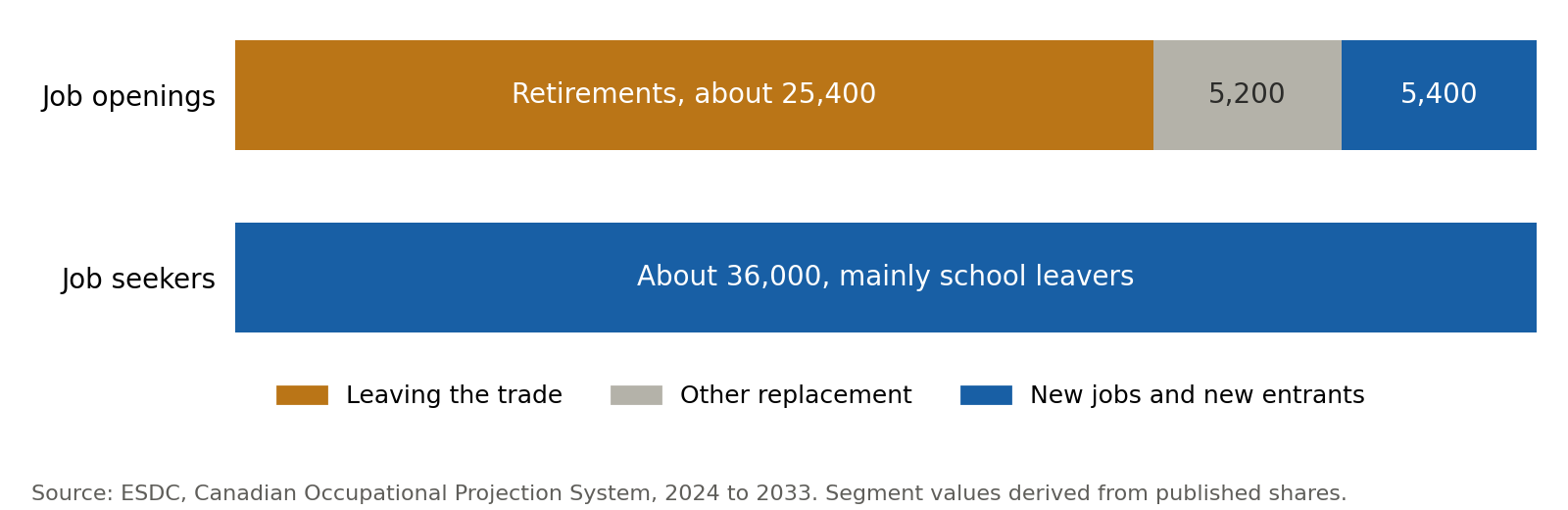
Projected job openings and job seekers for construction millwrights and industrial mechanics, 2024 to 2033.
About 85% of projected openings replace existing workers rather than add new positions, against roughly two-thirds for the average occupation, and most of those replacements are retirements. The largest group of incoming job seekers, meanwhile, is school leavers.
The headcount can balance while the years spent learning one plant's machines don't transfer at all.
What retires with an experienced millwright isn't only a position to fill. It's the unwritten half of the maintenance schedule. A replacement can arrive fully certified and still not know that the second press on the line runs differently from the first. That knowledge was never about presses in general. It was about these presses, run this way.
The obvious response is to ask retiring staff to write everything down, and that rarely works as well as hoped. The scientist and philosopher Michael Polanyi observed that "we can know more than we can tell," and maintenance knowledge is a good example. Much of it is recognition: a sound or vibration that registers as wrong before anyone can say why. Research on apprenticeship points the same way, including Jean Lave and Etienne Wenger's studies of how people learn a craft, from tailors to meat cutters. That kind of knowledge passes between people mostly through doing the work alongside someone who already knows it.
What Can a Shop Borrow From The Regulator?
The timing, more than the paperwork. A shop can create the same occasions for its unwritten maintenance, and use them to pass the knowledge on while the people who hold it are still there.
A regulator's real contribution is a fixed occasion: a date on which the job happens and someone checks that it did.
- A map of who knows what. List the machines where one person is the only one who understands the quirks. The point is to see where knowledge is concentrated before anyone leaves.
- A cycle on every recurring task. Give discretionary checks a frequency too. Most maintenance systems, Odoo's included, can generate recurring requests, so an undone check stays open past its date instead of disappearing.
- A second pair of hands on scheduled jobs. Pair a newer technician with the experienced one on recurring work on critical machines. The schedule creates the teaching occasions.
- Notes written at the job. A line on the completed request about why something was adjusted is easier to capture than a handover document written in someone's last month.
- Someone who counts the misses. Review overdue and skipped tasks on a set rhythm, the way a regulator would.
None of this replaces hiring and training. It means a new technician arrives to a schedule they can learn from, not a gap where one person used to be. If you're setting this up in Odoo, kleverManufacturing covers how Kodershop brings maintenance and production together for manufacturers.
Who Should Remember The Maintenance?
The MRO Magazine panel described Canada's maintenance problem as one of capability as much as headcount, and that may be the most useful way to think about equipment reliability and maintenance this month. A regulator remembers some of a shop's maintenance. The rest depends on whoever happens to know it.
Writing it all down before the retirement party probably won't save that second kind of knowledge. Giving it a place on the calendar might, as long as there's a second technician standing next to the first one when the date comes around.