A planner at a mid-sized fabrication shop gets a recommendation from the scheduling engine: pull a customer's order forward, because a machine just opened up and the model has calculated it's the most efficient use of the slot. On paper, it's the right call. The planner declines it anyway. She knows that customer has a habit of changing order quantities in the final week, something that's happened three times this year and never once shown up as a flag in the system. She holds the slot for a smaller, less efficient job instead, because that customer never changes their numbers.
Three days later, the first customer calls to cut the order by 40 percent. The schedule the AI recommended would have needed to be rebuilt from scratch. The one she chose to run didn't.
That's not the AI failing. The recommendation was built correctly from the data it had. It's also not really a story about "trusting your gut" over the machine. It's a story about what an experienced planner knows that the system was never given a way to know, and why the ability to override, quickly and without penalty, might be the most important feature in any planning tool that claims to use AI.
Configuration and Judgment
This is really a Configuration versus Customization question, just one level up. Configuring a system well means giving it accurate lead times, real machine capacity, and honest cycle times, so its recommendations are built on solid ground. That's necessary.
It's also not sufficient, because some of what shapes a good scheduling decision was never going to live in a database field.
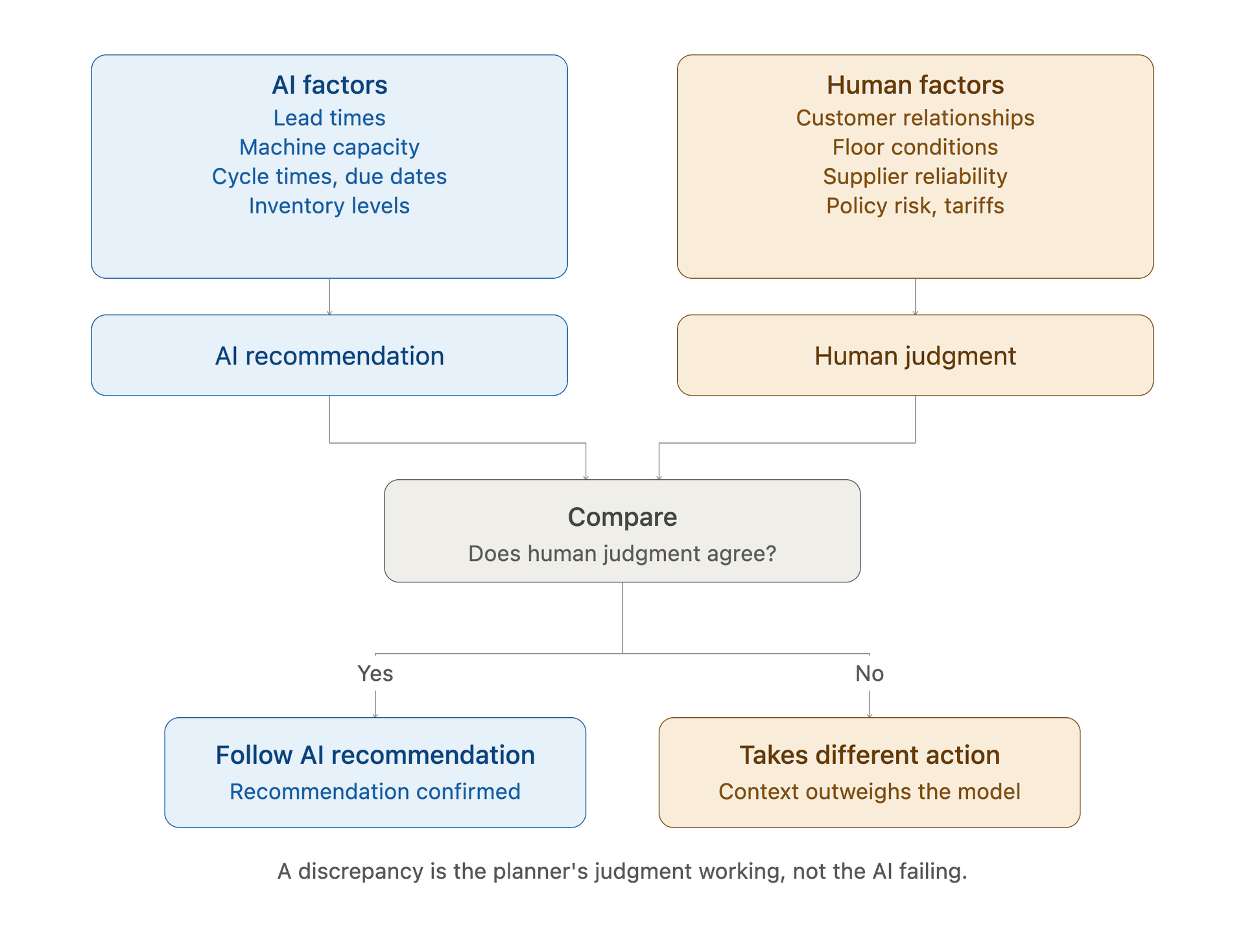
The AI is good at the part built from structured data. But context, relationships, and judgment calls are where a planner still must step in.
Why it Matters to Canadians
Manufacturers in Canada have spent the past year absorbing tariff changes, currency swings, and provincial-level funding gaps that shift faster than most planning software gets updated. Asautomation takes on more of the transactional work, human roles are movingtoward strategic oversight rather than disappearing. That shift shows up daily on the floor, not just in strategy decks. It's the planner deciding that a supplier's "on track" doesn't mean what it used to, or that a customer relationship is worth protecting even when the schedule says otherwise.
Further, as these systems take over more of the routine schedule-building work, the planner's role shifts toward reviewing what the system proposes and adjusting for context it can't fully capture. That's a reasonable description of where planning software is actually headed, and a more useful one than the version where the AI eventually needs no correction at all.
A Good Override Design
If a system treats every manual change as friction to be engineered away, it's solving the wrong problem. A few things worth expecting from the tools on your floor:
- Visible reasoning. You should be able to see why a recommendation was made before deciding whether to trust it, the same way you'd expect from a junior planner explaining their thinking.
- A cheap way to say no. Overriding a suggestion shouldn't take more clicks than accepting it.
- A reason field that actually goes somewhere. If the same type of override happens five times for the same reason, that's a pattern worth surfacing, not something that quietly disappears into a log nobody reads.
- No penalty for disagreement. A system that flags overrides as errors will train planners to stop explaining themselves, which is exactly the information you don't want to lose.
We've written before about how most ERP rollouts struggle for reasons that havenothing to do with the software itself, and the same principle applies here: a tool is only as good as the operational reality it's built around. The 2026 ERP trends we're seeing point toward systems that predict and recommend more than ever. That makes the override question more important, not less.
None of this is an argument against AI-assisted planning. It's the other half of the Configuration versus Customization question: configuring the data gets the recommendation right, but customizing how much room human judgment has is what makes the system usable on a real floor. The best planners aren't the ones who follow every recommendation. They're the ones who know exactly which ones to ignore, and why.