TL;DR
- A spare part lives in three places. On the shelf, in the record and in the market. Downtime tends to start where two of them disagree.
- Stashes are a trust signal. When people don't trust the storeroom, they keep their own supply, and the records drift.
- Duplicates hide stock you own. One audit found the same part under eight different stock numbers.
- Good records outlast suppliers. A detailed stock record helped one plant get a 1967 part made again.
- Canadian plants pay more for the gaps right now. Counter-tariffs since September 8 cover a range of US replacement parts.
What Happens When the Shelf and the Record Disagree?
At Home Market Foods, a food products company in Norwood, Massachusetts, three filters get changed every week on the breading equipment. The mechanic who does the job usually takes a full case of 12 and keeps it in the attic, so he doesn't have to walk to the storeroom next week. As far as the system knows, there are no filters left, so the reorder point tells purchasing to buy another dozen, and the cycle starts again.
The company's team told this story in Reliable Plant, a maintenance and reliability trade publication. Their diagnosis was simple: without trust between the storeroom and the mechanics, people hoard and over-order, and the data stops being accurate.
I picked this story to open with because nobody in it is doing anything wrong. The mechanic is saving himself a walk. Purchasing is following the reorder point. The attic stash is a small, sensible workaround, and it's also the moment the shelf and the record stop telling the same story.
Home Market Foods also found the same electrical push buttons stocked in several different OEM parts sections, and fixed it by standardizing on one manufacturer and one section. They describe inventory management as one of the first steps in their move toward reliability.
Why Does One Part End Up With Eight Records?
Because nobody types a part number the same way twice. In an audit for Fisher Control Parts, described in Reliable Plant by David Thompson of Ramsoft (UK), the numbers looked like this:
- 6,068 parts in the catalogue
- 1,256 could be removed, a 20% reduction
- 8 different stock numbers for the same part, in some cases
Thompson writes that most companies carry 10% to 15% duplicates. The causes are mundane: no field of its own for the manufacturer's part number, an "I" typed instead of a "1", or a supplier adding a size to the part number. How many ways could someone in your plant type "ball bearing"?
Each duplicate is a part the system says you don't have. That's the same gap as the attic, reached by a different route.
What If the Part Can't Be Bought at All?
The third gap sits between the record and the market. DTE Energy's plant in Monroe, Michigan, needed a replacement bearing sleeve for a fan that's central to its cooling. The original was made by Allis-Chalmers in 1967, and that company had long since stopped making it. According to an account by The Macomb Group, the industrial supplier that helped, the alternative was replacing the whole fan and bearing unit, with weeks of downtime.
- 1967: the original sleeve is made by Allis-Chalmers
- 1 sample sleeve was all the plant had to send for measurement
- About a month was spent finding a shop that could do the machining
Part of what made that possible was the plant's stock record, which held the dimensions, tolerances and original Allis-Chalmers part number a fabricator could work from. The plant also had time to wait, because its maintenance was planned ahead. That detail matters. A record that says "fan bearing, large" would have been no help to anyone. The knowledge that helped was written down, which is a theme we came back to in our piece on maintenance deadlines and the skilled trades retirement wave.
What Do the Three Stories Have in Common?
Each one is a gap between places where a spare part exists. A part is on a shelf, it's in a record, and it's either available to buy or it isn't. Reliability depends on those three agreeing, and the work of a storeroom is mostly keeping them in line.
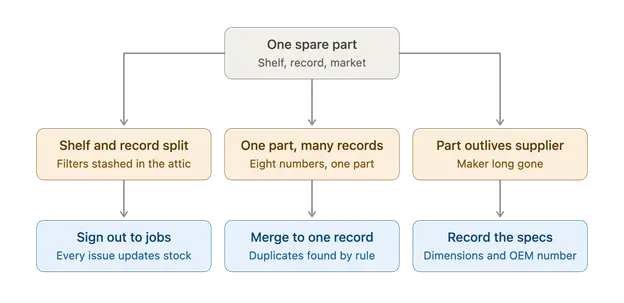
The fixes in the bottom row aren't large projects. What they share is that each one makes the record more dependable than the workaround it replaces.
Why Do the Gaps Cost More in Canada Right Now?
Since September 8, 2026, Canada's counter-tariffs on US goods have included a range of replacement parts. Equipment Journal lists rates that include:
- 25% on parts of pumps
- 15% on parts for forklifts and other works trucks
- 15% on other parts for cranes, earthmoving and excavating machinery
A reorder triggered by an attic stash or a duplicate record is a purchase you didn't need. If it's for a US-made part on that list, it may now carry a surcharge too. Goods imported for use in manufacturing or processing may qualify for remission, as customs broker Cole International explains, and whether your maintenance spares count is worth asking your own broker. Supply uncertainty can also encourage stashing, so the first gap can widen just when it costs the most.
What Makes a Spare Parts Record Worth Trusting?
A record people use more than they use the attic. Here's what that tends to involve:
- Every part leaves on a job. Home Market Foods moved to barcode scanning so technicians sign materials out to work orders. The count stays honest because taking a part and recording it become the same step.
- One record per part. Keep the manufacturer's part number in its own field. Odoo's Data Cleaning app (Enterprise) can flag likely duplicates using rules you set.
- Descriptions in a fixed order. Home Market Foods writes every motor the same way, type first, then horsepower, speed, frame and material. That makes it possible to search for a usable substitute when the exact part is out.
- Specs on the parts that matter most. Dimensions, tolerances and the original part number are what a fabricator could work from in DTE's case.
- Criticality before quantity. Home Market Foods says that when a machine went down for lack of a motor, it used to buy two. That left a lot of spares that never moved.
If we were starting this with a plant, we wouldn't begin with every part. We'd start with the machines that cost the most when they stop, list the spares behind them, and make sure each one has a single record, a location and enough detail to rebuy or remake it. If you'd like help setting that up in Odoo, the team behind kleverManufacturing is happy to talk it through.
Where Does Equipment Reliability Start?
This month we've been looking at equipment reliability and maintenance, and most of that conversation happens at the machine. These three stories put some of it somewhere else: in an attic, in a catalogue and in a stock record written decades ago. The mechanic with the case of filters isn't the problem to solve. He's evidence that the record wasn't yet worth trusting. Make it more dependable than the attic, and the attic tends to empty itself.
Kodershop has no affiliation with Home Market Foods, Fisher Control Parts, Ramsoft (UK), DTE Energy, The Macomb Group or Cole International. The stories above are drawn from the published sources linked in the article.