TL;DR
- Tax was already low. Finance Canada puts the marginal effective tax rate on new manufacturing and processing investment at -0.4% before the Mega Deduction and -1.2% after it.
- Production machinery isn't the big change. It has been immediately expensable since 2025. For machinery, the Mega Deduction mainly makes that permanent.
- Confidence is the bottleneck. Firms are delaying investment and favouring like-for-like replacement over upgrades.
- The missing figure is cost-to-keep. A near-zero book value makes an old machine look free next to a new quote.
One line in Finance Canada's numbers on the new Productivity Mega Deduction is easy to miss. Before the measure, the marginal effective tax rate on new manufacturing and processing investment was already -0.4%. With it, the rate falls to -1.2%. A rate below zero means that, at the margin, the tax system subsidizes the next dollar spent on equipment instead of taxing it.
Manufacturers are still holding off. If tax isn't what's in the way, what is?
This month we've been writing about equipment reliability and maintenance. The repair-or-replace decision is where that work turns into a spending question, and it's where the answer to that question is most likely to be found.
What Does The Mega Deduction Change For Production Machinery?
Less than the headlines suggest. Manufacturing and processing machinery has qualified for immediate expensing since that treatment was reinstated for property acquired from January 1, 2025, as part of what Budget 2025 called the Productivity Super-Deduction. It was temporary: full expensing for property available for use before 2030, then a phase-out over the following four years.
The Mega Deduction, proposed on September 15, 2026, would make immediate expensing permanent for most depreciable property acquired on or after that date. According to Finance Canada, that takes eligibility from about 15% of capital investment to about two-thirds. Used equipment can qualify too, subject to rules on who owned it before.
For a plant, the practical change is that the 2030 cliff for machinery disappears. The measure is still at the draft legislation stage, so confirm how it applies to a specific purchase with your accountant.
If Tax Isn't The Constraint, What Is?
The Canadian Chamber of Commerce's Business Data Lab addressed this in its Q2 2026 report. It found the investment slowdown has more to do with confidence than with financing. Firms are postponing investment and putting replacement spending ahead of productivity-enhancing investment, and manufacturers have responded to trade uncertainty more sharply than other sectors.
That pattern says something about how repair-or-replace decisions get made under pressure. A like-for-like replacement needs only a quote. An upgrade needs a case, and a case needs a baseline: what the current machine costs to keep running. Without that number, waiting looks free, and a tax incentive can't change a comparison that's missing one side.
Why Does an Old Machine Look Free?
Because its costs are scattered and its book value is small. Parts sit in purchasing, labour hours in the maintenance log, lost output in production reports. The asset register, meanwhile, may show a machine that's close to fully depreciated. Next to a new quote, a near-zero figure wins, even while the machine is costing more each quarter.
Here's where each half of the decision usually lives, and where the two need to meet.
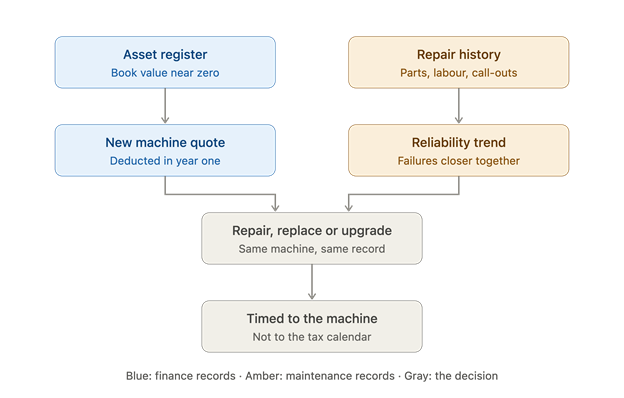
The new machine's cost is one quote away. The old machine's cost has to be kept on record.
Neither column is hard to fill on its own. The work is keeping both against the same machine, so the comparison doesn't have to be rebuilt every time something breaks.
What Should You Have on File Before Deciding?
- A cost-to-keep figure. Parts, labour and outside service over the last year or two, in one number you can set beside a quote.
- A failure trend. Whether breakdowns are coming closer together says more than last month's count.
- Lost hours. Time the work centre sat idle, so downtime carries a cost and not only a tally.
- Book value alongside cost. Seeing both together stops a near-zero figure from reading as "free."
How Can Odoo Keep Both Records Together?
Odoo's Maintenance app lists each piece of equipment with its mean time between failures, mean time to repair and an estimated next failure date, and these update as failures are reported and repairs are closed. The equipment record also holds what the machine cost to acquire. Purchases and bills for parts and outside service can carry an analytic account for that machine, and Odoo Accounting can hold the asset itself. That's configuration, with no custom code: setting things up so the same machine carries the same name everywhere.
If you'd like a second look at how your maintenance and asset records line up, our team is happy to help; our kleverManufacturing page explains how we work with manufacturers. A repair history is also only as good as what gets logged, which is the subject of our piece on maintenance and the skilled trades retirement wave.
What Does Reliability Have to Do With Capital Spending?
Most of this month's theme has been about keeping machines running. The Mega Deduction adds a reason to keep good records of how they run, because once tax stops being the obstacle, the maintenance file is what's left to make the case. The deduction will still be there next year. Whether the machine deserves another year is something only that file can show.
This article is general information, not tax advice.