A multi-level Bill of Materials (BoM) represents products built from manufactured subassemblies, each with its own components and production requirements. When the same subassembly appears in multiple finished products, manufacturers need a replenishment strategy that balances shared availability with demand-specific production.
Design a BOM Structure Around Shared Work
We recommend creating each reusable subassembly as its own product, configuring it for manufacturing, and creating a separate manufacturing bill of materials before adding it to parent-product BOMs. Each level should represent a real planning, purchasing, quality, or production boundary.
For example, one equipment model may require one control panel while a larger model requires two. Both parent BOMs can reference the same control-panel BOM, rather than carrying duplicate lists of enclosures, wiring assemblies, terminals, and electronics.
This bill of materials structure gives engineering changes one home. If the control panel needs a different enclosure or additional terminals, future requirements for every parent product using that subassembly may change. Before releasing a revised BOM, manufacturers should follow a documented engineering change process. This includes reviewing the impact on affected parent BOMs, obtaining the required approvals, and defining an effective date or production order boundary for the new revision. This helps ensure that production teams use the correct BOM version for each manufacturing order.
To apply this structure consistently, manufacturers should follow these practices:
- Create a separate product and BOM for each reusable manufactured subassembly.
- Add that subassembly as a component on each finished-product BOM.
- Keep purchased components within the BOM level where they are consumed.
- Treat kit BOMs separately, since kits are fulfilled differently from manufactured subassemblies.
Choose the Right Subassembly Replenishment Rule
For shared manufactured subassemblies, Odoo 20 documents two replenishment approaches: a 0/0/1 reordering rule and the Replenish on Order (MTO) route combined with Manufacture.
A 0/0/1 reordering rule uses a minimum quantity of zero, a maximum quantity of zero, and a replenishment quantity of one. When demand reduces the forecasted quantity below zero, Odoo triggers replenishment using the selected route. With the Manufacture route, this creates a manufacturing order for the subassembly. The resulting stock is not reserved for a specific sales order, so it can be allocated to another production requirement if priorities change.
MTO plus Manufacture follows a different approach. When the relevant demand is confirmed, Odoo creates a manufacturing order linked to that demand. The resulting subassembly quantity is reserved for the originating requirement rather than being freely available for another order.
For manufacturers using shared subassemblies, the 0/0/1 rule provides more flexible stock allocation. MTO is more suitable when production must remain linked to a specific customer order, project, or traceability requirement.
Both approaches depend on correct product configuration, a manufactured subassembly with its own BoM, and appropriate replenishment routes. Manufacturing lead times and component availability must also be considered when planning the parent product. For a broader look at inventory replenishment strategies and stock control, read our guide to Smarter Inventory Control for Manufacturing Teams.
Expose Material Risks Across Every BOM Level
A finished product may appear ready to build while its shared subassembly is blocked by a missing electronic part, a long-lead enclosure, or an earlier production requirement. That is why planners need visibility beyond the top-level BOM.
The BoM Overview provides a way to review component requirements across multiple levels. When the Forecast option is enabled, planners can inspect free-to-use quantities, component availability status, estimated completion dates, and lead times. This helps identify whether a shortage affects the finished product directly or originates within a manufactured subassembly.
This visibility applies to the BoM data maintained within a single Odoo database. If manufacturing operations use separate databases, the BoM Overview does not consolidate component requirements across them.
Manufacturing Orders also provide component availability information that helps production teams identify missing materials before work is completed. The exact readiness status depends on the configured manufacturing readiness policy.
Ask one practical question: “Is the delay caused by an unavailable control panel, a missing component inside the control panel, or an operation that cannot begin until another operation is complete?”
The following tools and features address different planning and production needs:
- Reordering Rules and MTO routes determine how products are replenished.
- Multi-level BoMs show product and component relationships across production levels.
- Work Order Dependencies define the sequence in which manufacturing operations are performed.
- Work Orders, routings, and work centres support the organization and execution of production operations.
Compare a 0/0/1 Reordering Rule with MTO for a Shared Subassembly
Consider a hypothetical Canadian equipment manufacturer producing two industrial equipment models: the NorthLine 200 and NorthLine 400. Both products use the same manufactured control panel, identified as CP-10.
The NorthLine 200 requires one CP-10, while the NorthLine 400 requires two. The control panel has its own BoM, which includes an enclosure, wiring assembly, terminals, and controller. Both finished-product BoMs reference this shared subassembly.
Option 1: 0/0/1 Reordering Rule for Flexible Shared Stock
The manufacturer configures a 0/0/1 reordering rule for CP-10 and selects the Manufacture route. The minimum and maximum quantities are set to zero, and the replenishment quantity is one.
Suppose the company confirms sales orders for two NorthLine 200 units and one NorthLine 400 unit. Together, these orders create demand for four CP-10 control panels. If this demand reduces the forecasted CP-10 quantity below zero, the 0/0/1 reordering rule triggers replenishment.
When the reordering rule is triggered, Odoo uses the selected Manufacture route to generate manufacturing orders for the required CP-10 quantity. The replenishment quantity is calculated in increments of one unit, based on the rule's To Order setting.
Once completed, the control panels enter available stock without being reserved for one specific sales order. If the NorthLine 400 order becomes more urgent, the planner can allocate available CP-10 units to that production requirement instead of keeping them tied to the original demand.
This approach is useful when both equipment models use an interchangeable, standardized control panel and production priorities may change.
Option 2: MTO + Manufacture for Demand-Specific Production
The manufacturer can instead configure CP-10 with the MTO and Manufacture routes.
When a sales order for a product requiring the CP-10 subassembly is confirmed, Odoo triggers replenishment through the MTO route. With Manufacture configured, it creates a manufacturing order linked to the originating sales order. The required CP-10 quantity is reserved for that demand and cannot be used to fulfil a different sales order.
For example, the two control panels required by a NorthLine 400 order remain associated with that production requirement. They are not freely available to cover a shortage on a different order.
This approach is more suitable when control panels have customer-specific specifications, project requirements, or traceability obligations that make reassignment undesirable.
Which Approach Fits the Production Model?
For the hypothetical manufacturer, the 0/0/1 rule is the stronger choice if CP-10 is interchangeable across both equipment models and planners need allocation flexibility. MTO is preferable when each control panel must remain tied to a specific customer or production requirement.
The decision should also account for manufacturing lead times, component availability, and the consequences of changing production priorities. A replenishment rule can trigger supply, but it cannot eliminate shortages in the components needed to build the subassembly.
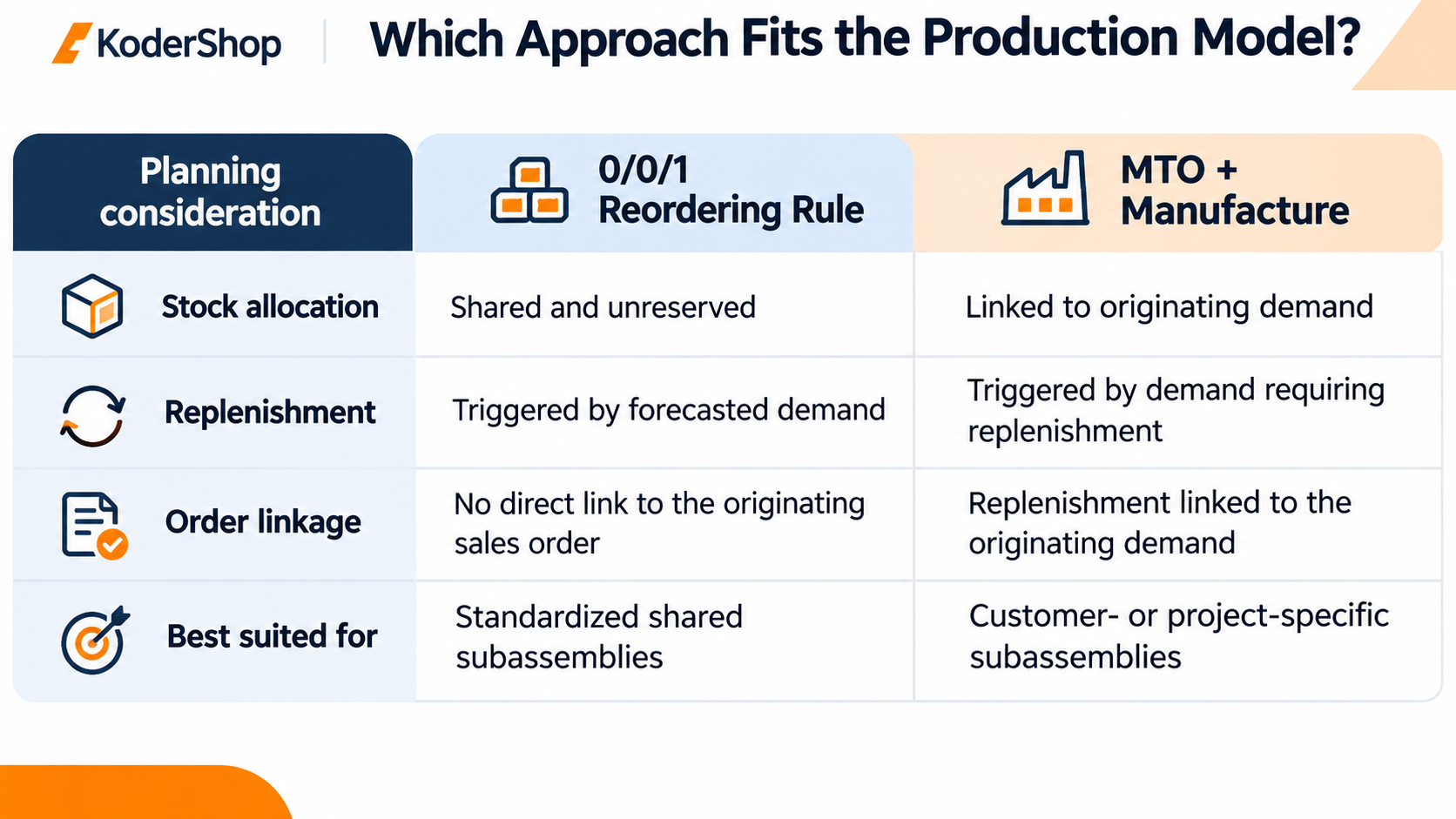
Comparison of 0/0/1 Reordering Rules and MTO + Manufacture for Shared Subassemblies.
Turn BOM Visibility Into Better Production Decisions
A multi-level BOM delivers the most value when it helps you decide how shared subassemblies will be supplied, allocated, and protected from shortages across competing production orders. Separate BOMs work best for reusable production units. Shared-stock replenishment suits flexible allocation, while demand-linked replenishment suits demand-specific supply. Operational sequencing is separate from material supply.
Before changing production rules, we recommend testing representative products, lead times, routes, and competing demand scenarios in a controlled environment. That review helps ensure the BOM structure and replenishment approach match the way your shop actually plans and builds products.
Turn Shared Subassemblies Into Clearer Planning Decisions
Kodershop helps manufacturers align Odoo workflows with the operational realities behind every multi-level BOM. We can assess where shared subassemblies create planning conflicts and define an approach that supports reliable purchasing, production, and delivery commitments. To discuss your requirements with our team, contact us.