TL;DR
- What goes wrong? Custom orders get quoted from a spreadsheet, and the BoM is built after the customer signs.
- Why does it hurt? A custom order's cost depends on the options chosen, so any change in material, supplier or duty hits margin unseen.
- What fixes it? Generating the BoM from the configuration at quote time, with cost and origin data on every component.
- How does Odoo do it? Variant BoMs, variants created on sale, component-level data, and make-to-order routes keep the quote and the build on one record.
"We manufacture what our customers want," Isabelle Liard, president of Quebec's Liard Industries, told a House of Commons committee in April 2026. The company has built custom steel equipment for over 50 years:
- ~$5 million in annual sales
- ~70% of sales go to the US
- 5% to 8% was what the US steel tariff used to add to a project's value
- 25% is the tariff now, on the full value of nearly all its steel products
Liard said she can't absorb it. I chose this case because it shows how far one cost line can move when every order is different.
Tariffs are the sharpest recent example. The underlying problem is older: in make-to-order, the price depends on a configuration that often doesn't exist as data until after the quote goes out.
Why Do Make-to-Order Quotes Go Wrong?
Because the quote comes before the BoM. A make-to-stock manufacturer prices each SKU once and updates a list. A make-to-order shop's SKU only exists once the customer signs, so sales often prices from a spreadsheet or a similar past job, and engineering builds the BoM afterwards.
So what happens when a cost input moves? A material price, a supplier change, or a duty rule can each affect some configurations and not others. Current US metal tariffs show how specific this gets: per PwC Canada, products with 15% or less steel, aluminium or copper fall outside them, and a reduced 10% rate applies above 85% US-origin metal by weight. Swap a steel guard for a polymer one, or source a part from a US supplier, and the same product can land in a different band.
If the BoM is built after the quote, that difference comes out of your margin.
What Does Product Control Mean When the Product Doesn't Exist Yet?
It means controlling the rules that generate each configuration. Engineering and product control usually focuses on keeping an existing BoM accurate and versioned. Make-to-order needs control one step earlier: which options exist, which components each option pulls in, and what the system knows about those components. Could you say which components each option on your quote pulls in? Get that right and every quote inherits accurate data. Get it wrong and every quote becomes a rushed engineering job.
How Does Odoo Keep the Quote and the Build on the Same BoM?
- One BoM, many configurations. Each BoM component line can be set to apply only to specific variants. Lines with no variant set go into every build. No separate BoM per combination.
- Variants created when sold. With the "Dynamically" creation mode, Odoo creates a variant only when that combination is added to a sales order.
- Data on the component. Purchased components carry cost and weight, and can carry an HS code and country of origin.
- Built to the order. With the Replenish on Order (MTO) and Manufacture routes, confirming the sales order creates the manufacturing order for that configuration.
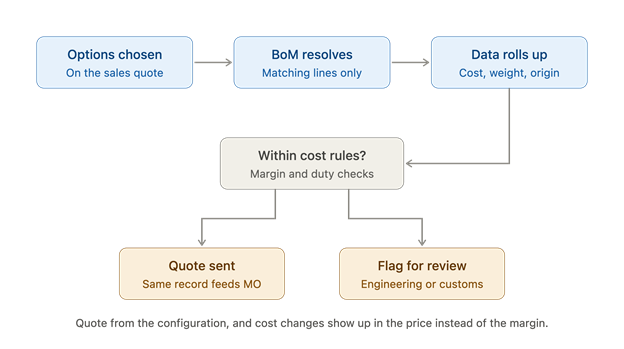
Standard Odoo won't check a configuration against rules like a minimum margin or a tariff threshold on its own. That's a small layer on top of data Odoo already holds, and it's where configuration versus customization matters: rules and rates belong in editable settings because they change. If you're weighing this up, our team at Kodershop is happy to help scope it as part of a kleverManufacturing implementation. It costs far less to design in early than to add after go-live.
What Should Canadian Make-to-Order Shops Plan For?
More rule changes and tighter documentation. Key dates, per PwC:
- April 6, 2026: Section 232 duties move to the full customs value of covered goods
- December 31, 2027: current treatment ends for one category of CUSMA-qualifying goods
- January 1, 2028: higher rates apply to that category
PwC also warns that US Customs can penalize fraudulent or deliberately misrepresented US-content claims.
Liard told the committee tariff specialists cost $100 to $200 an hour. A customs broker given a component-level breakdown of each configuration can answer quickly; one given a PDF quote can't.
What Does Good Practice Look Like?
- Data on every purchased component. Cost, weight and origin, kept current.
- Options mapped to components. Each choice a salesperson makes points to specific BoM lines.
- Rules as settings. Updating a margin floor or duty threshold shouldn't need a developer.
- Flags for judgement calls. Configurations that break a rule go to someone who can weigh them.
- One record from quote to build. The approved configuration is the one the shop floor builds.
Where Does Product Control Start Now?
Product control used to start in engineering, with the drawing and the approved BoM. For make-to-order shops, it starts when a salesperson picks an option. Tariffs just made the cost of quoting before the BoM exists harder to ignore.
Kodershop has no affiliation with Liard Industries. Details are from public testimony to the House of Commons Standing Committee on Industry and Technology, April 20, 2026. This article is general information, not customs advice.
Sources
- House of Commons Standing Committee on Industry and Technology, Evidence, Meeting No. 33, April 20, 2026
- PwC Canada, US tariffs on steel, aluminum and copper imports from Canada (June 2026 update)
- Odoo documentation: Managing BoMs for product variants, Product variants, Replenish on order (MTO)