TL;DR
- Two outages, same pattern. Algoma Steel's steelmaking stopped in 2024 and again in 2026 because supporting equipment failed: a utility corridor at the coke plant, then a power station turbine.
- The cost is lost production. The 2024 outage cut an estimated $120 million to $130 million from adjusted EBITDA, tied to about 150,000 tons that were never made.
- OEE points at the wrong asset. It logs downtime against the machine that stopped, so failures in supporting equipment can stay invisible.
- The cost is set before the failure. Which assets you track, how you record the cause, and what buffers and contingencies you have in place decide how much an outage hurts.
In August 2026, a turbine tripped offline at Lake Superior Power, the station that supplies Algoma Steel's mill in Sault Ste. Marie. The mill's electric arc furnace hadn't failed. It stopped anyway, for about 12 days.
Algoma had been here before: in 2024, a collapse at its coke-making facility took the blast furnace down for three weeks. In both cases, the equipment that failed wasn't the equipment that made steel. For a month on equipment reliability and maintenance, that's worth sitting with. The real cost of unplanned downtime is mostly decided before anything breaks: which assets you treat as production-critical, how you record a stop, and what you've arranged in advance.
What Happened, and What Did It Cost?
2024: Blast Furnace Outage
20 January
A utility corridor collapses at the coke-making facility, stopping the blast furnace.
Production resumes after 22 days.
Q4 results: about 150,000 tons of hot metal lost and $120M to $130M off adjusted EBITDA, insurance recovery undetermined.
That's about $5.5M to $5.9M a day, by our own calculation from the published totals. Whatever the size of your operation, run the same sum on your own line and the answer probably isn't comfortable either, right?
2026: Electric Arc Furnace Outage
Algoma announces that a Lake Superior Power turbine has tripped offline. The furnace stops while finishing and shipping continue. Estimated outage: up to 21 days with the contracted spare turbine, about 10 with interim grid power.
The furnace restarts on interim power from Ontario's grid operator, with the turbine still out of service.
Algoma says a replacement turbine has been installed. Q3 guidance: about 145,000 tons in expected shipments (419,173 a year earlier) and negative $10M to $20M in adjusted EBITDA.
30 October: In 1 Week
Full Q3 results expected, with no separate outage cost published yet.
Algoma's CFO tied the outage to lower volumes, but the comparison overstates the damage: the 2025 quarter ran mainly on the blast furnace that closed in January 2026, so much of the gap reflects the switch to electric arc steelmaking.
Either way, the headline numbers aren't repair bills. They're tons that were never made, priced at the margin they would have earned.
Why Does OEE Miss the Cause of This Kind of Downtime?
OEE, overall equipment effectiveness, is measured on the machine that stops. That seems sensible. The machine that stopped is the one that lost the time. In Algoma's case, it's also the blind spot. An August 2026 OEE report would typically show the furnace at zero availability for about twelve days. The number is correct, but it points at an asset that hadn't failed.
The same was true in 2024: the blast furnace stopped, but the failure sat in a utility corridor at the coke plant. Equipment reliability belongs to the whole chain of assets a line depends on, and that chain drops out of view when downtime is logged only against the machine that went quiet.
The reality is, unless you run a power station, the equipment holding up your line will look different from Algoma's, and the pattern still applies without much change. In a fabrication or food plant, the equivalent of Lake Superior Power might be the compressed air system, the chiller, the dust collector or the main electrical panel. When one fails, the stop gets recorded on whichever press, oven or filler sat idle, and a compressor behind many of the stops can go years without appearing in the data.
Here's how that plays out:
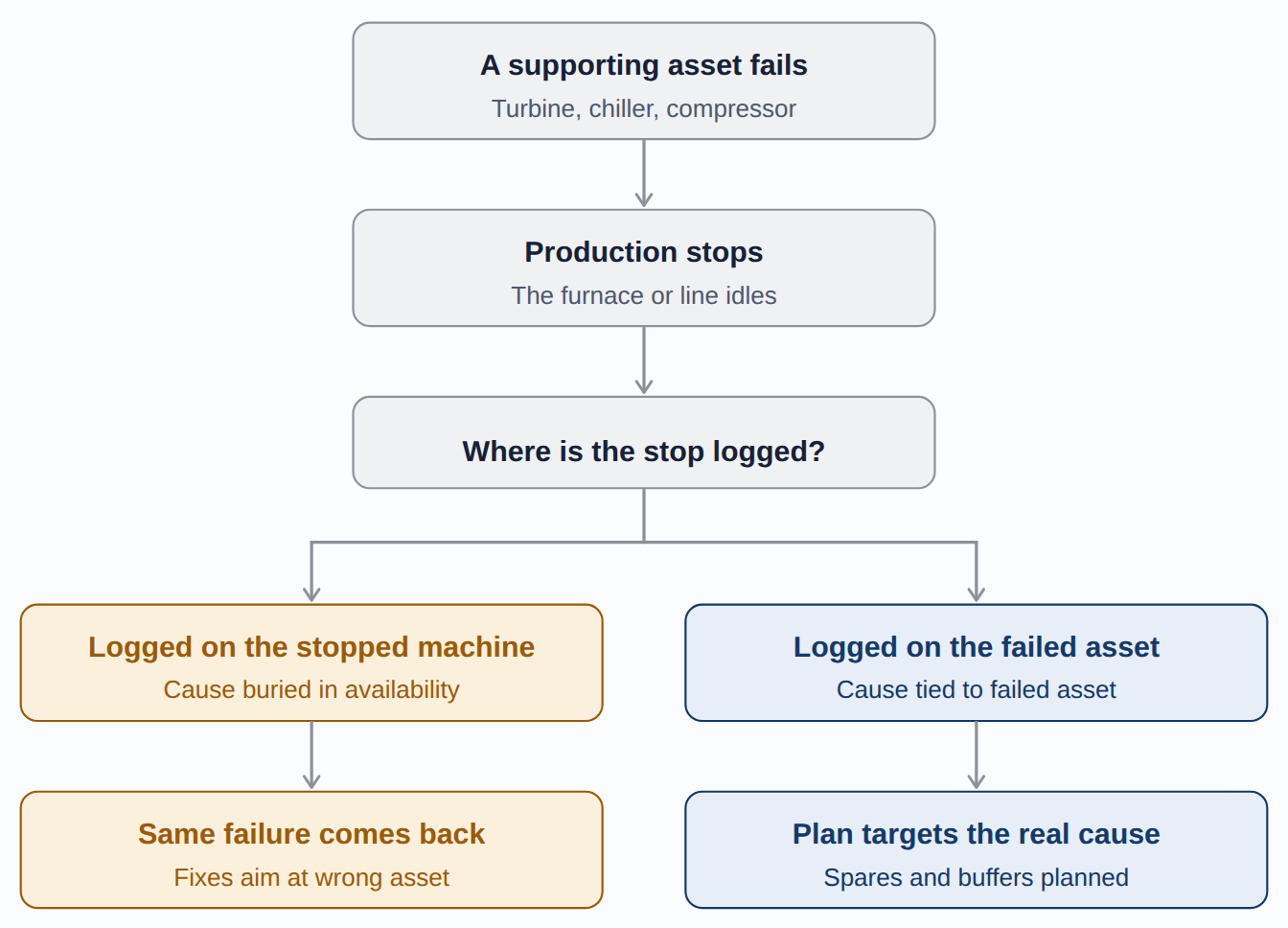
The left-hand path is the default when the asset register stops at the production floor, because people can only log stops against machines the system knows about. So here's a question worth asking about your own plant: when a compressor fails, which machine does the stop get logged against?
What Kept the Cost From Growing?
Algoma had options ready on the first day and worked two of them at once. A few things stand out:
- A spare turbine was already contracted. Algoma's service agreement with GE Vernova, put in place for this type of situation, let it put an upper limit on the outage from day one.
- Downstream kept running on inventory. Algoma didn't expect a significant impact on committed delivery dates, so the stop became a volume problem instead of a customer problem.
- Planned work was pulled forward. Algoma brought forward scheduled maintenance at the power station and, its CFO said, advanced commissioning on a second electric arc furnace.
- The grid became part of the plan. Interim power from Ontario's Independent Electricity System Operator got the furnace running, and the operator was reviewing upcoming planned outages to limit further interruptions.
None of this shows up in an OEE score. All of it shows up in the final cost.
Why Does Lost Capacity Hurt Canadian Manufacturers More in 2026?
Because for many of them, new equipment isn't in this year's budget. If you run a plant in Canada, you've likely felt this one already. From a KPMG Canada survey of 275 manufacturers in May, reported by The Hub:
- 57% reduced, paused or cancelled capital spending
- 42% moved or plan to move some or all of their production to the US
KPMG's warning is that the pullback compounds: equipment ages and productivity slips.
When capital budgets are frozen, the hours you recover from equipment you already own are the cheapest capacity available, and the hours you lose are the hardest to make back.
Algoma's case has a Canadian twist, too. Its furnace got going again on interim power arranged with Ontario's grid operator, a a reminder that the chain of supporting assets goes beyond the property line. Utilities, a single-source supplier or the one certified technician in the region can all play that role, and outside the major industrial corridors those dependencies tend to run longer.
What Should Downtime and Loss Tracking Capture?
Enough to price a stop and trace it to its cause. If we were sitting down with you at Kodershop to set up loss tracking in Odoo, this is where we'd start:
- Supporting assets on the register. If the compressor or chiller isn't set up as equipment, its failures get logged against whatever stopped downstream.
- Two reasons per stop. Record what stopped and what caused it. In Odoo, that means blocking the work centre with a loss reason and opening a maintenance request on the equipment that failed.
- Hours priced in margin. Minutes are easy to ignore. Lost output times contribution margin gets attention, and tells you whether a spare part is worth keeping on the shelf.
- How long your buffer lasts. Algoma kept shipping because it had inventory. Knowing your days of cover after each critical stage tells you what an outage there will cost.
- A maintenance backlog ready to pull forward. Downtime is a chance to do planned work, but only if it's already scoped, with parts and labour lined up.
- Contingencies recorded with the asset. Service agreements, alternate suppliers and rental options belong on the equipment record, where a planner can find them at two in the morning.
If you've been following this month's series on
“Equipment Reliability & Maintenance”, you'll remember we looked at where a shop's maintenance knowledge lives, much of it with staff
approaching retirement. Loss tracking is the other half of that record: what
each failure cost and where it came from. kleverManufacturing
covers how Kodershop brings maintenance, production and inventory together in
Odoo. And if you'd like a second pair of eyes on your own asset register and
downtime reasons, the Kodershop team is always happy to have that conversation.
What Does This Case Say About Equipment Reliability?
What stayed with me most while going through Algoma's updates was how little of the story was about the turbine itself. The most valuable reliability decisions are often made far from the asset that fails, and well before it does. Algoma's spare-turbine agreement was in place before the turbine tripped, and the interim power arrangement got the furnace back in under two weeks. Neither appears in an OEE report. Reliability work tends to show up as the hours that never had to be recorded, so it's worth making sure your log can see the whole chain of equipment.
A quick word on why I picked this case. Because Algoma reports to shareholders, both outages come with published dates, tonnages and costs, so we can follow a stop from the moment it happens to the bottom line. And because the two outages hit different furnaces under different conditions, they help separate the lessons about one machine from the lessons about downtime in any plant, including yours. Kodershop has no affiliation with Algoma Steel. This piece draws on the company's public disclosures and news coverage.