Odoo 20 is coming. It will be unveiled at Odoo Experience 2026 in Brussels, running September 24 to 26, and the manufacturing world is already asking the question that comes up every release cycle: do we upgrade now, wait a few months, or sit this one out entirely?
For a lot of small and mid-sized manufacturers, the honest answer is that the release date isn't really the date that matters. What matters is what you do between now and then. There's real groundwork worth starting today, on your current version, regardless of when you actually move.
Here's a practical way to approach it, based on what we've walked manufacturers through on previous Odoo releases.
The Launch Date isn't the "Go" Date
Odoo Experience is where the version gets unveiled, not where it becomes something you should install in a live production environment. General availability typically follows two to four weeks after the conference, and the first stable, production-ready patch usually doesn't land until October or November.
That time gap exists for a reason. Early releases carry the bugs that only show up once thousands of businesses start running real workflows through them. If you're managing production schedules, inventory counts, or shop floor operations on Odoo, you want the groundwork done before that patch lands.
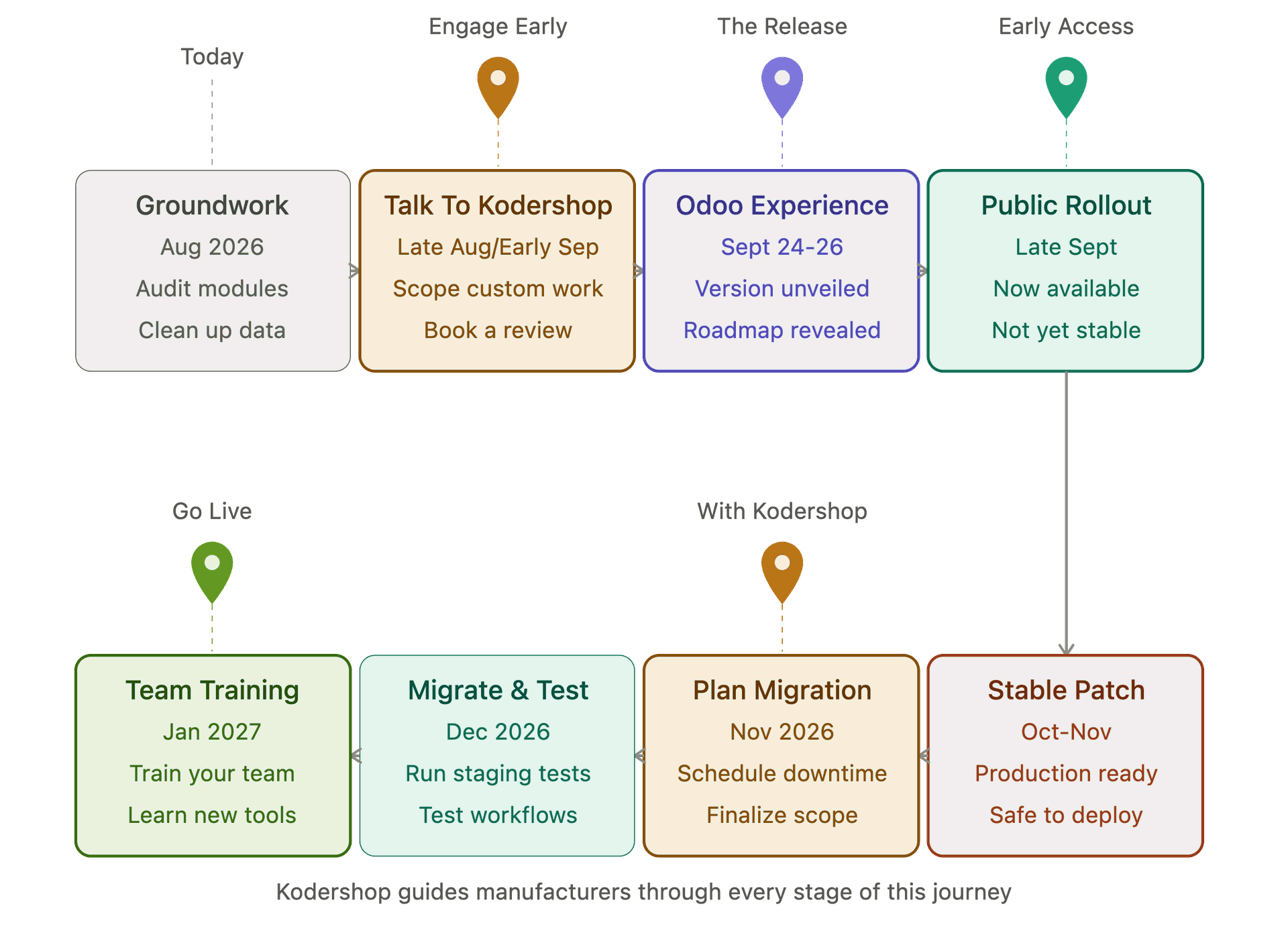
A simple rule of thumb: plan your migration around the first stable patch, and use the months before it to get everything else in order.
Why the Odoo 20 Release is Worth Paying Attention To
Most annual Odoo releases are incremental. Odoo 20 looks a little different. The direction, based on the roadmap Odoo has shared so far, is toward AI that lives inside the tools you already use rather than existing as a separate app you have to remember to open. Instead of a chatbot bolted onto the side of your ERP, the aim is AI quietly doing more of the work inside accounting, records management, and day-to-day processes, including tasks that previously needed a person to initiate them.
That's a bigger structural shift than a typical version bump, which is exactly why it's worth exploring now instead of reacting to it once it lands. Understanding what's changing gives you time to decide what's useful for your operation, rather than sorting through it under pressure during a live migration.
What this means if you're already running Odoo
An upgrade moves your existing database to a newer version. Your data, workflows, users, and installed modules carry forward with it. It is not a fresh install, and your team won't need to relearn the system.
Most of what changes between versions sits underneath the surface: schema updates, refined views, new fields, targeted additions to existing screens. The screens your team uses to log production, check stock, or process an order will still look and work largely the same. Odoo also provides a test database and an upgrade report with every upgrade request, so you can see exactly what's different in your own instance before anything goes live, rather than guessing from general release notes.
The Real Barrier
Here's the part that gets skipped in most upgrade conversations:
Across the manufacturing sector right now, the vast majority of companies say they're exploring or actively considering AI-driven automation. Far fewer say they feel genuinely ready to use it at any real scale. That gap comes down to infrastructure: clean data, consistent processes, and systems that are set up to actually take advantage of automation once it's available.
This is the filter worth applying now, well before Odoo 20 stabilizes. New AI capabilities inside your ERP won't do much if your inventory data is inconsistent, your workflows are held together with manual workarounds, or nobody on your team has had time to think through where automation would actually help. Getting that foundation in place is what lets you use new features as soon as they're available, instead of running an updated system that behaves the same way the old one did.
What to Explore Now
None of this requires waiting for the release. Most of it is groundwork you can start this month, on the version you're already running:
Where do you stand?. Confirm your current version and how many versions behind Odoo 20 that puts you. A jump from several versions back is a bigger project than a single-version upgrade, so this shapes your timeline more than the release date does.
What's been customize?. Custom modules and integrations are usually the actual bottleneck in any Odoo migration, not the core platform. Pull a list of what's been built on top of your Odoo instance and whether it's still needed.
Is your data ready? If inventory records, BOMs, or production data have accumulated inconsistencies over time, clean them up regardless of your upgrade timeline. It's easier to do now than during a migration, and it improves your current system in the meantime.
Have you documented your workflows? Write down how production scheduling, stock movements, and order processing actually run today. That gives you something concrete to test against once you're on a newer version.
Do you need a test database? If you're on a supported version, you can request an upgraded test database well ahead of any production move, and try real workflows on the newer version with your own data before committing to anything.
What do you need? Once you can see what Odoo 20 offers, ask which parts solve a real problem for your operation, versus which parts are simply new. Adoption doesn't have to be all or nothing.
The Bottom Line
The most useful thing most manufacturers can do between now and the stable release is start exploring, not stand still. Get customizations documented, data cleaned up, workflows clarified, and a test upgrade requested, so that whenever you do move to Odoo 20, you're positioned to use what's new right away.
That's what automation without complexity looks like in practice: doing the groundwork early, so the upgrade itself is the easy part.
If you'd rather have someone map this out with you than do it alone, that's the kind of scoping review we run with manufacturers ahead of a release. Book a conversation with Kodershop before the September announcement, and you'll already know where you stand by the time Odoo 20 goes live.