Manufacturers face growing requests for emissions information from customers, supply-chain partners, and reporting frameworks. A carbon footprint in manufacturing helps quantify greenhouse gas emissions across a defined organization, site, and reporting period. It can also show where better operational data is needed.
Odoo 20 ESG uses available business records from modules such as Accounting, Fleet, and Employees, alongside manually entered activity data. It applies emission factors to this information and classifies estimated emissions by scope. The results depend on the records and factors available; the module does not automatically measure emissions from every machine, production order, supplier, or product.
Understand the Main Sources of Manufacturing Emissions
The GHG Protocol groups emissions into three scopes. Scope 1 covers direct emissions from sources the organization owns or controls, such as fuel burned in company vehicles, boilers, furnaces, and generators. Scope 2 covers indirect emissions from purchased electricity, steam, heating, and cooling. Scope 3 includes other value-chain emissions, such as purchased materials, freight, employee travel, and waste generated in operations.
For example, a manufacturer may use utility bills to estimate purchased-electricity emissions, fuel records for its own vehicles to assess Scope 1, and supplier or freight information to estimate parts of Scope 3. Scope classification depends on the organization’s reporting boundaries and chosen methodology, so categories should be documented consistently before comparing periods.
How Odoo 20 ESG Supports Emissions Analysis
Odoo 20 ESG is an Enterprise application; its ESG and Carbon Footprint functionality is not available in Community Edition. For a detailed overview of the available functionality, refer to the official Odoo 20 ESG documentation. Organizations using Community would need another solution, such as a third-party module, external sustainability platform, integration, or custom development.
The calculation model is:
Activity Data × Emission Factor = Estimated Emissions
Odoo uses accounting records from Fixed Assets, Expenses, Other Expenses, and Cost of Revenue accounts to estimate emissions from business activities such as purchases and expenses. For employee commuting, it combines data from the Fleet and Employees apps, including vehicle model CO₂ emissions, employee home-to-work distance, and office attendance. Activities not covered by these sources, such as waste, can be added manually.
Emission factors convert activity data into estimated greenhouse gas emissions. Odoo can import factors from the ADEME source database, and Odoo 20 adds AI-assisted emission-factor assignment. These capabilities are also outlined in the Odoo 20 Release Notes.
Odoo 20 supports automatic emission factor assignment through rules based on the product, partner, and account recorded in a transaction. All criteria defined in a rule must match. When several rules apply, Odoo prioritizes product matches first, followed by partner and account matches. The Odoo 20 release also introduces AI-assisted emission factor assignment.
Before accepting an assigned factor, review its activity description, unit of measure, geographic and date relevance, GHG Protocol scope, and any assumptions or uncertainty. Odoo's available source database includes ADEME, the French Agency for Ecological Transition. Since these factors may reflect French conditions, Canadian manufacturers should check whether they are appropriate for their location and reporting period. Depending on the factor's calculation method, emissions may be estimated using physical quantities or monetary values.
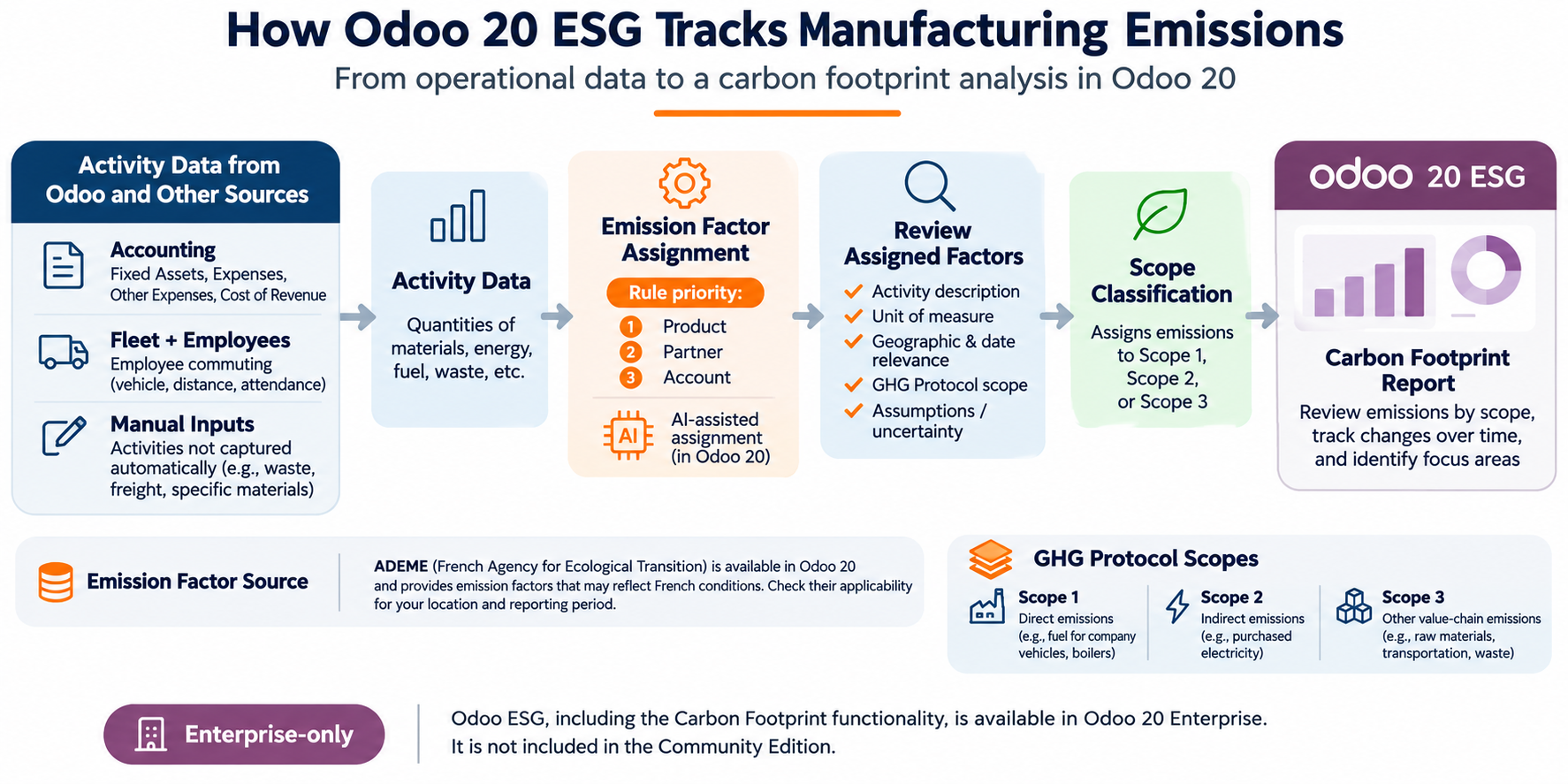
Odoo ESG does not, by itself, provide verified actual emissions for every supplier or a complete product-level footprint. Machine-level energy use, supplier-specific Scope 3 data, and detailed production allocations may require metering, supplier data, imports, integrations, or tailored reporting.
Example: Reviewing a Canadian Manufacturer’s Emissions
Consider a hypothetical Canadian manufacturer of fabricated components. It buys steel, aluminum and packaging; operates company delivery vehicles; receives electricity bills; and uses an external waste contractor. This example is illustrative.
Accounting records may provide purchase and utility activity data, while Fleet and employee records may support vehicle and commuting calculations. Waste quantities and some freight information may need manual entry or an import from another system. After suitable factors are assigned, including a provincial grid factor for purchased electricity, managers can review the resulting estimates by scope and activity.
A review might compare purchased-electricity emissions (Scope 2), company-vehicle fuel (Scope 1), purchased metals and packaging (generally Scope 3), and waste treatment (generally Scope 3). If one category rises, managers should first check record completeness, units, factor relevance, scope classification, and changes in production volume before deciding what action to take.
Use Emissions Data to Set Operational Priorities
A useful baseline needs consistent reporting boundaries, periods, data sources, calculation methods, and documented assumptions. Once established, the baseline can help managers compare monthly, quarterly, or annual estimates and investigate material changes.
The findings can guide questions about material choices and supplier data, electricity use per production unit, vehicle routes and fuel consumption, and scrap, recycling, and disposal. Detailed facility energy optimization may still require submetering or specialist energy-management tools; see our article, “Energy Management in Manufacturing: How to Monitor and Improve Energy Efficiency,” for that topic.
Some disclosure requirements also go beyond standard ESG data. Supplier-specific Scope 3 reporting, product carbon footprints, assurance-ready disclosures, and customer- or jurisdiction-specific templates may require external datasets, integrations, consulting, or custom reporting.
Build a More Reliable Carbon Data Foundation
A manufacturing carbon footprint is only as dependable as its activity data, emission factors, scope boundaries, and documented assumptions. Odoo 20 ESG can help manufacturers organize selected records and identify areas for further investigation, while additional data sources and connected systems can support more detailed analysis.
KoderShop helps manufacturers connect Odoo with operational and external data sources to improve visibility across production, purchasing, fleet, and energy-related processes. Contact KoderShop to discuss ERP workflows that support your emissions-data and reporting requirements.