Every year, the Information and Communications Technology Council and Next Generation Manufacturing Canada ask several hundred Canadian manufacturers how their digital transformation projects turned out. In the most recent report, published in July 2026, only 23 percent said their initiative from the past five years had been fully successful. Eight percent called it an outright failure. The rest sit somewhere in between: live, technically functional, and quietly short of what was promised.
None of the top reasons manufacturers gave for that gap was that the software itself didn't work. Respondents pointed instead to uncertainty about how new technology would fit into existing operations, trouble integrating with legacy equipment, and misalignment among leadership about what the project was even for. The platform is rarely the variable that decides whether a transformation lands. Who ran it, and how the manufacturer chose them, usually is.
When does an ERP partnership get tested?
Not during the sale. The demo, the reference calls, the feature checklist against a requirements document, all of that happens before either side has any real information about what working together is like. The test comes eighteen months later, when a routing changes, a new location comes online, or a support ticket sits open through a production run.
This is where "manufacturing transformation" as a phrase starts to mislead people. It sounds like an event with a start and an end: pick the software, implement it, go live, done.
What it is, for most mid-sized manufacturers, is a standing condition: a system that keeps needing configuration as the business keeps changing, for as long as the business keeps changing.
Evaluating an ERP partner as a one-time purchasing decision, rather than as the person a manufacturer will be having this relationship with for most of a decade, is the mismatch behind a lot of that 23 percent.
Manufacturers who treat implementation as something to hand off entirely, or something to keep entirely in-house, often make this mistake for the same underlying reason: they're optimizing for the go-live date instead of for what happens after it. There's a real case for outsourcing the work rather than building the capability internally, but only if the partner on the other end of that decision is being evaluated on the years after handoff, not just the handoff itself.
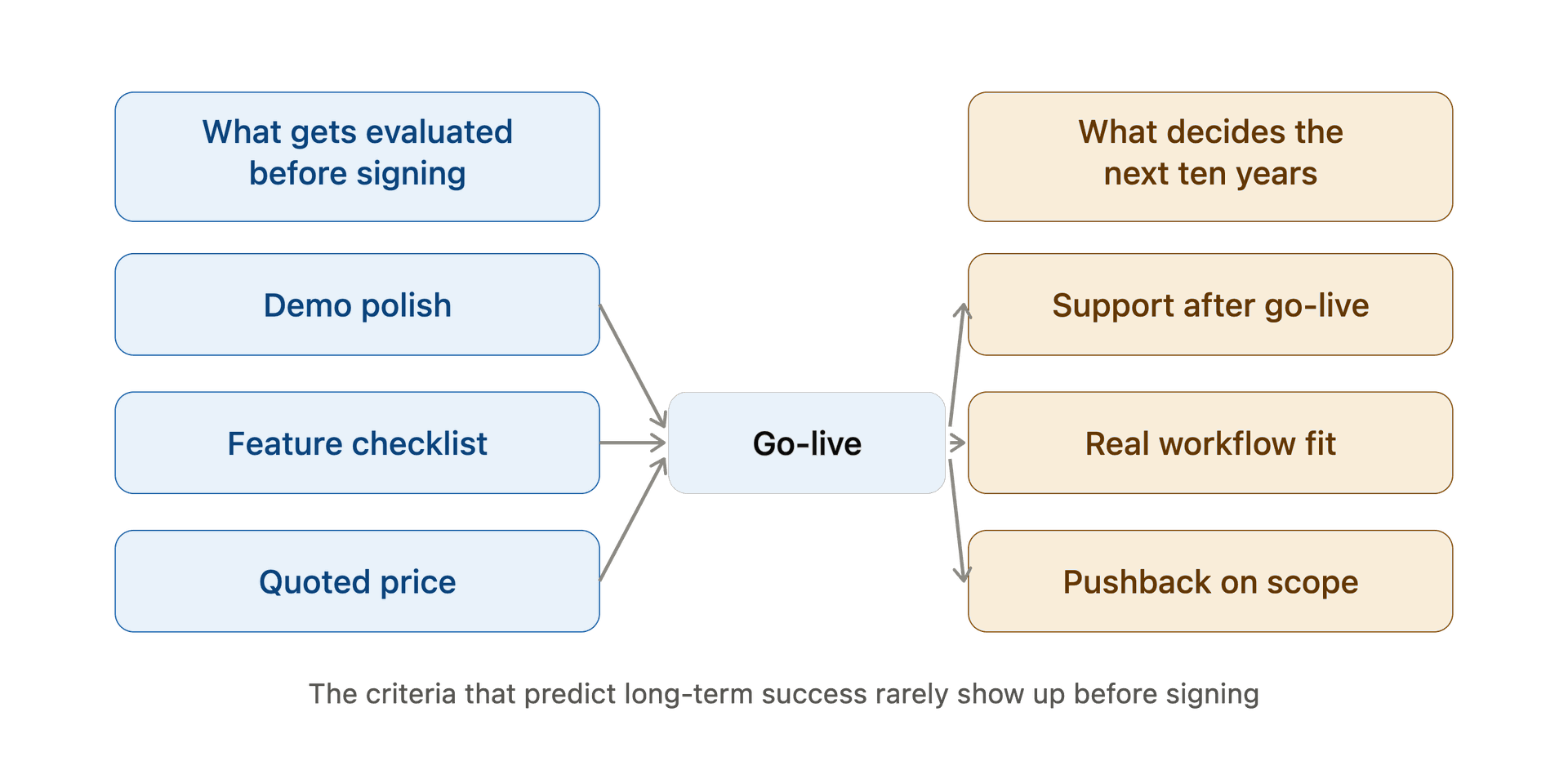
The gap between those two columns is the whole argument. Nothing on the amber side shows up on a scorecard built for the blue side, which is exactly why so many manufacturers pick a partner well by the criteria they were using and still end up disappointed a year or two in.
Why does Canada's tariff environment make this harder to get wrong twice?
Canadian manufacturers aren't choosing ERP partners in a vacuum this year. The 2026 Advanced Manufacturing Outlook Report, an annual survey run by Plant and Canadian Manufacturing Online, found manufacturers responding to tariff pressure, inflation, and currency swings by becoming more selective and ROI-driven about technology spending rather than pulling back on it outright. Investment hasn't stopped. It has gotten more concentrated, which means each individual decision is carrying more weight than it used to.
That changes the math on partner selection specifically. A manufacturer with room to run three parallel pilots and walk away from the two that don't work can afford an evaluation process that's mostly gut feel and a good feeling from the demo. A manufacturer watching input costs and export exposure move with every trade announcement can't. If the ERP decision goes sideways, there often isn't a second budget cycle a year later to fix it quietly. The evaluation has to work the first time, which puts real pressure on getting the criteria right rather than reaching for the ones that happen to be easiest to compare in a spreadsheet.
What should manufacturers check before signing?
- Ask about month three, not month one. Every partner can describe their go-live process in detail. Fewer can describe, specifically, what support looked like for a comparable client three months after launch: who picked up the ticket, how fast, and what happened when the fix needed more than a settings change.
- Push past the reference-call script. A partner will hand over three happy references without being asked twice. The more useful question isn't whether they're happy; it's whether the original timeline held, what changed in scope along the way, and whether they'd hire the same team for a second project.
- Look for a partner willing to say no. Scope creep is rarely one dramatic decision. It's a string of small, reasonable-sounding yeses to requests that weren't in the original plan. A partner who pushes back on some of those, even when it costs them billable hours, is telling a manufacturer something about how the relationship will run once the ink is dry.
- Find out who's still on the account. Implementation teams and support teams aren't always the same people. Ask directly whether that's the case, and if it is, ask how continuity gets managed when the handoff happens.
None of this shows up in a demo. That's the point: the criteria that predict long-term outcomes and the ones that are easy to line up side by side on a shortlist are, for the most part, two different lists.
Does manufacturing transformation ever finish?
Not in any way a go-live date can mark. It's an operating condition a manufacturer settles into, and the partner chosen to run it is either built for that or isn't. The 23 percent who called their project fully successful weren't necessarily working with better software than everyone else. They were more likely working with someone who was still answering the phone eighteen months in.