TL;DR
- The tariff base moved. Since April 6, 2026, U.S. duty on many steel, aluminum and copper derivatives applies to the full value of the product, with an exemption for listed goods whose metal makes up less than 15% of their weight.
- Your BoM holds the answers. Metal weight and metal origin both come from your bill of materials, and both now help decide what a shipment pays.
- Dates matter as much as accuracy. It helps to be able to say which BoM revision was in use when a particular order shipped.
- Small changes add up. A supplier swap or a floor substitution that never becomes a revision leaves your BoM describing an older version of your product.
- Product control now faces outward too. Engineering & Product Control is still about building what you designed. This year, it's also about being able to show someone else what you built.
On April 14, 2026, BRP, the Valcourt, Quebec powersports company behind Ski-Doo and Can-Am, suspended its full-year guidance. The U.S. had changed how it calculated metals tariffs, effective April 6. For BRP's snowmobiles and most of its off-road models, a 25% tariff on the whole vehicle replaced a 50% tariff on just the metal inside it. BRP estimated the extra cost at more than $500 million for the rest of the year, before any mitigation. The rate went down. The bill went up.
I chose this example because of what it shows about where tariff questions end up. BRP's release describes a change in how duty is calculated, and says nothing about how its vehicles are made. And once the border starts caring about what a product is made of, sooner or later the question lands on your bill of materials.
What Does BoM Accuracy Mean When Tariffs Look at Your BoM?
In short, it means your bill of materials needs to describe your product the way a customs officer would weigh it, and keep doing that after every change.
For a long time, a BoM mistake mostly stayed inside the building. A wrong quantity meant a short line, a costing error, maybe some scrap. Frustrating, but fixable. The 2026 rules give the BoM a second job. Under the revised U.S. Section 232 rules, listed goods whose applicable metal is less than 15% of their total weight are no longer subject to the metals tariffs, except for goods classified in the U.S. tariff schedule's metal chapters (72, 73, 74 and 76). Listed derivatives above that line pay on their full value. There's also a reduced 10% rate for certain products made with U.S. metal, and a June proclamation lowered the bar for it from 95% to 85% U.S.-melted or smelted metal.
Have a think about where those two numbers would come from in your business. Metal weight comes from your components, their materials and their quantities. Metal origin comes from which supplier's parts went into which build. U.S. customs already asks for both: importers keep reporting where steel was melted and poured and where aluminum was smelted and cast, and anyone claiming the under-15% exemption reports the total weight of the applicable metal on the entry. If that information lives in your BoM, you can find it. If it lives in a spreadsheet or someone's inbox, it's going to take a while.
How Does Engineering & Product Control Change When the BoM Matters at the Border?
Product control has usually been checked on the shop floor: did the right parts, in the right revision, reach the people building the product? That's still the first test. The second one, which matters more this year, is whether you can show what the product was after it's left. To my mind, that's where version control has quietly become part of product control.
Here's a simple example of how it plays out. Say an engineer swaps a steel mounting bracket for an aluminum one to save weight. On the floor, it's a small update: a new part number, the same operation. At the border, depending on the product, that swap could move it across the 15% line, or change how much of its metal was melted or smelted in the U.S. One change, two very different readers.
If nobody flags the second reading, that's not the engineer's fault. They did their job with the information the process gave them. The gap is in the process, which was set up for a time when a bracket was only a production question.
It's also worth dating changes that seem to have no tariff impact at all. If someone ever asks whether a change mattered, the date is what lets you answer with confidence.
Why is This Worth More Attention For Canadian Manufacturers in 2026?
Mostly because this year has given manufacturers plenty of reasons to change what goes into their products, while the rules for how those products are taxed kept shifting.
Think about the sourcing questions you may have faced. A lower U.S.-metal threshold from June could make U.S.-made metal worth a second look for some products. Canada's own 25% surtax on a list of imported steel derivatives, introduced on December 26, 2025, changed the cost of some inputs. Any of these can lead to a different supplier or a different part. So it's worth asking yourself: how many of your sourcing changes this year became a BoM revision, and how many only exist in a purchasing email?
Here's what that difference can look like when the same supplier swap takes two different routes:
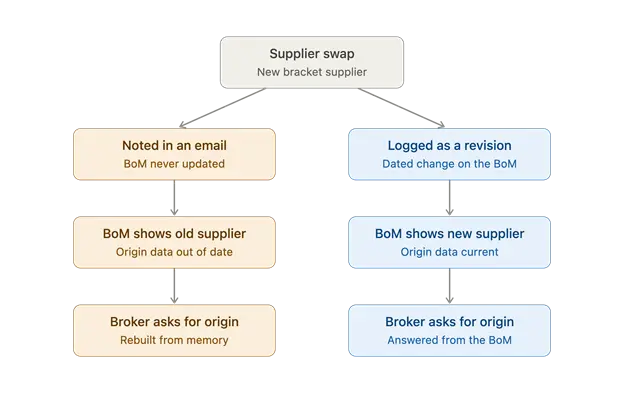
Same supplier swap, two very different afternoons when the broker calls.
On the day of the swap, the two routes can look almost the same. The difference tends to show up later, when someone needs the answer and the person who made the change has moved on to other things.
The rules themselves have also moved more than once. The April proclamation, the June adjustment and October guidance on how U.S. content is counted for certain USMCA-qualifying Canadian goods have each changed the calculation within a single year. If your BoM has a clean history, you can check how your products fare under each new rule. If it doesn't, you'll be piecing things together from memory each time.
What Does Good BoM Version Control Look Like in Practice?
You don't need to overhaul everything at once. A lot of it comes down to making sure certain details live in one place. Here are a few things I'd look for:
- Material and weight on each component. If metal weight sits in an engineer's spreadsheet, every tariff question starts with a search. Having it on the BoM saves that step.
- Origin linked to the part you buy. When a supplier changes, it helps if the BoM reflects that too, even if the part number stays the same.
- One route for changes. Substitutions made on the floor during a shortage are still changes. It's worth giving them an easy way back into a dated revision, ideally one an operator can start right from the work order.
- Dates you can look back on. You should be able to ask "what was the BoM for this product on March 3?" and get one clear answer.
- A heads-up for whoever handles customs. Changes that affect metal content or origin are worth flagging to that person before the next shipment goes out.
If you're on Odoo, its PLM (product lifecycle management) app already routes BoM changes through engineering change orders and keep a history of which version was active on which dates. From there, it's mostly about deciding which details matter for your products and making the change process easy enough that everyone uses it, purchasing included.
If we were sitting down with your team, we'd probably start with a small exercise: pick three shipments from this spring and see whether you can tell which BoM revision each one left with. How long that takes is a good sign of where you stand. If you'd like a hand, our kleverManufacturing page is a good place to start, and we're always happy to talk it through.
Where Does This Leave Product Control?
Engineering & Product Control has always been about making sure the product you designed is the product you build. This year adds another question to that: can you show someone else what you built, on the day you shipped it? BRP's announcement was about tariffs, but I think the takeaway for smaller shops starts much earlier in the process. The people who look after your bill of materials may turn out to be the people your customs broker most needs to hear from in 2026, and good version control is what helps them give a clear answer when that call comes.
Kodershop has no affiliation with BRP Inc. The company is referenced here as a publicly reported example.