A Canadian steel reported a line in its quarterly results called direct tariff costs. For the quarter ending June 30, 2026, it came to $18.7 million, down from $64.1 million a year earlier. The drop reflected a decision to stop shipping to the United States: US-bound volume fell to 23 per cent of total shipments, against a historical range of roughly 45 to 55 per cent. Speaking to analysts in May, the company’s chief executive said it is more exposed to tariffs than virtually any steel company in North America.
Set the size of those numbers aside and look at what's unusual about them. The company can say what a tariff costs it, to the dollar, every ninety days. It's a listed company, and quarterly reporting forces the number into existence whether anyone in the building wants it or not. Most Canadian manufacturers carry a version of the same exposure with no equivalent line anywhere in the business.
Knowing the number is only half of it
The company’s own filings point at the harder problem. The company has reported that in most cases it hasn't been able to pass tariff costs to customers, because the Canadian steel market trades largely on spot pricing while the US market runs on contracts. That's worth sitting with. The exposure wasn't set by the tariff. It was set years earlier, by how the company's commercial relationships were structured, and by the time the tariff landed there was nothing to renegotiate.
Most manufacturers meet a smaller, faster-moving version of this. A component line lands on a new tariff list on a Thursday. The quote book was priced in the spring on 60-day validity. Sales wants to know by Monday which quotes are still worth honouring. An important question, but when can it be answered?
That question was never in the ERP business case. The case, written two years earlier, was built on hours: data entry avoided, month-end close shortened, duplicate purchase orders eliminated. Every number in it was defensible, countable, and about a steady state that no longer exists.
Cost of Slow Answers
The cost of taking three weeks to work out which quotes are exposed is the need to react before the analysis even lands, and it only has blunt options.
It can honour everything and absorb the difference, which on a decent-sized quote book is a number worth a manager's job. It can go back to every customer with a revised price, including the majority whose products contain none of the affected parts, and spend credibility it will need again in six months. Or it can freeze quoting, which is the option most shops quietly pick, and which costs the most while looking like caution.
Speed buys selectivity. Say a shop has 300 open quotes and can establish by Monday that 40 of them carry the affected part, and that a dozen of those are thin enough to go negative. That's twelve phone calls instead of 300, made while the customer still remembers reading about the tariff in the news. Three weeks later, the same call sounds like a company that can't manage its own costs. Same facts, different conversation, and the difference is response time.
Efficiency is Peace
Most ERP value gets argued as efficiency Reasonable, when input costs moved once a year and a quote stayed valid for as long as it said it did.
Under 2026 conditions, the more valuable property is the ability to re-cost, re-quote and re-plan on a compressed timeline, over and over, without a special project each time. That's a duration, not a rate, and almost nobody measures it. Ask a plant how many hours the ERP saves per week and someone will produce a figure. Ask how long it takes to trace one purchased part upward into every quote, order and product that touches it, and you'll get an estimate, which is the tell.
There's a commercial payoff hiding in that duration, and the spot-versus-contract problem above is the clue to it. Quote validity is a term customers weigh, and in a volatile input market it's one of the few terms a manufacturer can differentiate on without cutting price. Shops that can't re-cost quickly protect themselves by shortening validity to 15 or 30 days, which reads to the buyer as instability and pushes them toward whoever will hold a number longer. A shop that can re-cost its whole book in a day can hold 45 or 60 with a clear conscience, because it knows it can catch the exposure before the customer accepts. Response capability turns into a contract term you can sell.
Transformation: What Can You Answer?
Manufacturing transformation usually gets described as things added: automation, connected equipment, a planning layer with some intelligence in it. A more useful measure is the set of questions a company can answer at commercial speed, and how that set grows.
The ERP doesn't produce those answers. It decides whether they're reachable at all: whether costs are versioned, whether bills of material carry enough structure to trace a part upward rather than only downward, whether a quote records the cost basis it was priced on rather than just the number it landed on. Those are unglamorous implementation decisions, usually made in a week nobody remembers, and they're what separates four hours from three weeks.
One input cost change sets off four separate investigations.
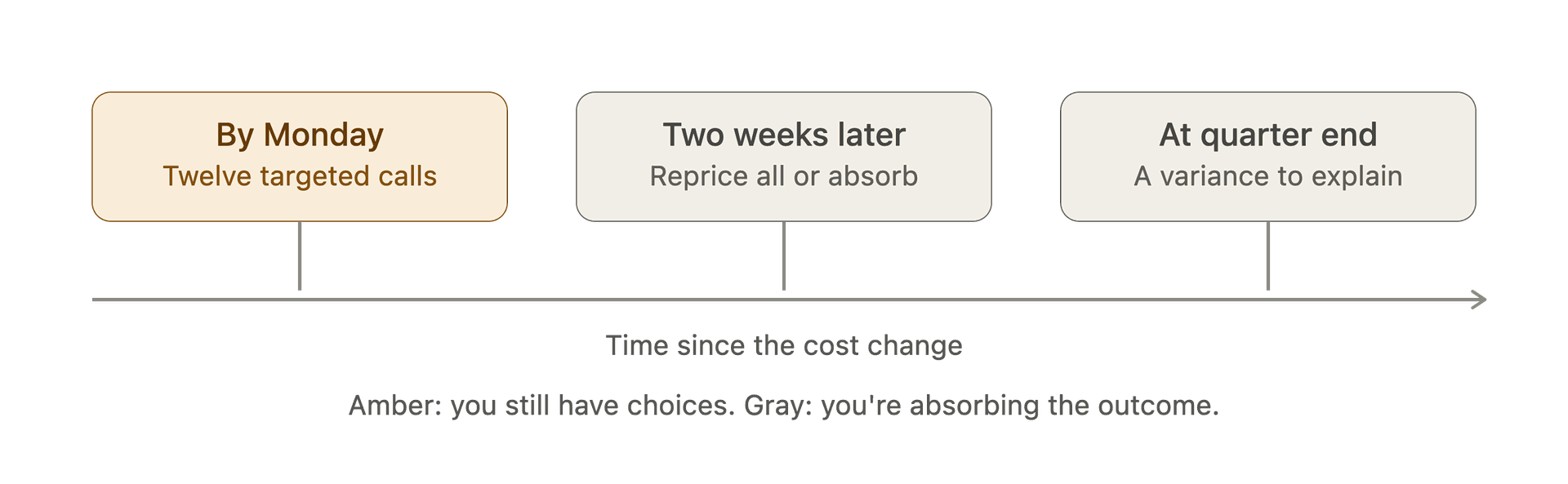
Four questions, four owners, four different clocks. Purchasing knows about the commitments within a day. Sales finds out about the quotes when a customer accepts one. Finance sees the whole thing at quarter end, as a purchase price variance, which is the most expensive possible way to learn something you could have known in April. Most manufacturers aren't slow at all four. They're fast at one, and they let the answer they can reach stand in for the answer they need.
Why 2026 Keeps Producing Thursdays
Canadian manufacturers are getting an unusual number of these afternoons. The Financial Accountability Office of Ontario, the legislature's independent analysis body, modelled the tariff scenario against a no-tariffbaseline and found manufacturing to be the hardest-hit sector in the province, with real GDP roughly 8 per cent lower in 2026 and about 57,700 fewer manufacturing jobs. The exposure isn't evenly spread either: Windsor, Guelph, Brantford and Kitchener-Cambridge-Waterloo carry more of it than the provincial average, because that's where export-focused manufacturing sits.
Smaller firms feel it as a pricing problem rather than a GDP one. Trade press coverage of CFIB research this summer found that two in five Canadian exporters to the U.S. reported selling products caught by the proposed 50 per cent tariffs, with most of those expecting revenue to fall. Export Development Canada's tracking of the same stretch shows manufacturing output and employment under sustained pressure while the wider economy grew.
Then add the currency. A shop buying tooling and components in USD and selling in CAD carries two moving variables against quotes priced when both sat somewhere else, and the CUSMA review timeline supplies a third.
There's an overlooked commercial consequence in all this. Plenty of Canadian manufacturers already have material surcharge or price adjustment clauses in their larger supply agreements, negotiated in the last two years for exactly this situation. Those clauses usually require substantiation: show the input cost move, per part, with dates. A company that can't produce that evidence inside the notice window loses protection it already paid for at the negotiating table. The clause is worth as much as your ability to document it on demand, which makes it a data structure question wearing a legal costume.
The Form
There's a second reason this return goes unrecorded: It doesn't fit the paperwork, and the paperwork is more specific than most people assume.
Look at how the programs are built. Ontario's Advanced Manufacturing and Innovation Competitiveness stream asks applicants to invest at least $500,000 and commit to creating at least five new or upskilled jobs, and part of the loan can be forgiven if those investment and job targets are hit. Ongoing operations, maintenance and capital replacement are explicitly ineligible. Alberta's manufacturing productivity grant matches up to $30,000 against technology and equipment, following an operational assessment. Both are sensible program designs. Both also point the reward at headcount and capital outlay, and neither has a field for "we can answer a costing question in four hours instead of three weeks." Capital committees ask for the same shape, because a payback calculation only consumes rates.
So the capability drops out of the application, out of the board deck, and then out of the post-implementation review, which measures the project against what the application claimed.
The odd thing is that the same finance function
already knows how to value this. Treasury pays a premium to hedge currency
exposure it can't forecast, and nobody asks for the payback period on an
option. Operations carries a structurally identical exposure, priced in
decision latency instead of basis points, and treats it as unbudgetable because
it lacks a unit. It does have a unit. Time the exercise, before and after.
That's a countable number and it's closer to the truth about what the
investment bought than an estimate of keystrokes saved.
What to Look For
If response time is what you're buying, these are the details that decide whether you get it.
- Costs that carry their history. A standard cost overwritten on each change tells you what a part costs today and nothing about what you quoted on.
- Traceability that runs upward.Every system tells you what goes into a product. The reverse, from one part out to every quote and open order that touches it, depends on how yourbills of material and manufacturing orders are structured.
- Quotes that remember their basis. A quote should record the cost assumptions behind it. Without that, re-costing a back catalogue means rebuilding six months of assumptions by hand, and the rebuild is where the errors come from.
- Origin and classification as fields, not attachments. Country of origin and tariff classification usually live in customs paperwork, which means exposure analysis starts with a filing cabinet.
- A rehearsal on a quiet week. Invent a cost change on a part you buy, and time how long it takes to produce the four answers. The gaps surface immediately, they're specific, and they're far cheaper to close in advance than during a real one.
None of this is exotic. It's configuration work that's easy to defer because nothing breaks when you skip it, and expensive to retrofit at the exact moment you need it.
Transformation You Can Measure
Two manufacturers can run the same ERP, same version, same modules live, and give completely different answers on Thursday afternoon. What separated them was the implementation being treated as either a system of record or as a mitigation tool, and that distinction is most of what transformation means once the launch photos are filed. It shows up in what changed after go-live rather than in what got installed.
The steel producer above had the advantage of knowing its number and still couldn't move fast enough to protect the margin, because the constraint sat in commitments made long before the tariff. Most manufacturers don't have that excuse. Their constraint is that nobody can produce the number at all. So the honest test is the next unplanned cost shock, and whether the building can answer it before the customer does.