The field of data analytics is undergoing a fundamental transformation, shifting from static dashboards and manual workflows toward dynamic, AI-driven collaboration. Plotly, the company behind the widely used visualization framework and Dash analytics platform, is helping drive this shift with the introduction of Plotly Studio's new Agentic Mode.
While Plotly Studio is just one example in a rapidly evolving market, it is emerging as one of the leading products helping define the trend toward agentic analytics. Its latest developments provide a useful lens through which to examine how AI agents are reshaping data analysis workflows across the industry.
For software development and ERP implementation teams, this evolution is particularly significant. As organizations seek to connect operational data with AI-driven decision-making, the ability to integrate analytics, business applications, and enterprise systems is becoming increasingly important. At Kodershop, we are seeing growing interest in agentic workflows that bring together AI, analytics, and business systems to support faster, more informed decision-making.
Plotly Studio's new capability represents a major step in the evolution of analytics, introducing a conversational, autonomous approach to working with data. Instead of building analyses step by step through code or rigid interfaces, users can now interact with intelligent agents that plan, execute, and refine complex workflows in real time.
From Dashboards to Dynamic Intelligence
Traditional data tools, including earlier versions of Plotly Studio, focused heavily on structured dashboards built from single datasets. While powerful, this approach often limited flexibility and required significant manual effort. Agentic Mode removes these constraints by enabling a fluid, chat-based environment where users explore, analyze, and build applications through natural language.
This shift changes the role of the user. Instead of acting as a developer or analyst responsible for each technical step, users become directors, guiding an AI agent that can independently plan multi-step analyses, fetch data, perform calculations, and generate outputs.
Autonomous Data Exploration
At the heart of Agentic Mode is autonomous exploration. When connected to a data source, the system can automatically inspect the dataset, propose analyses, and generate insights without requiring explicit instructions for each action.
The agent operates by:
- Creating multi-step execution plans
- Running queries and calculations
- Producing tables, summaries, and visualizations
- Iterating based on user feedback
This allows users to start with broad or vague questions and progressively refine their analysis. The system handles complexity behind the scenes, enabling deeper insights with less effort.
Unrestricted Data Connectivity
One of the most significant improvements is the removal of the “one-table-per-project” limitation. Agentic Mode enables simultaneous connections to multiple data sources, including databases like Snowflake and Databricks, APIs, and local files such as CSVs or Excel sheets.
This capability is essential for real-world analytics, where answers often require combining data across systems. By integrating these sources seamlessly, Plotly Studio enables cross-functional analysis without the need for extensive data engineering.
AI-Assisted Development of Applications
Beyond exploration, Agentic Mode enables users to build full-scale data applications using natural language. With minimal prompting, the agent can generate interactive dashboards and Dash apps that incorporate complex logic and visualizations.
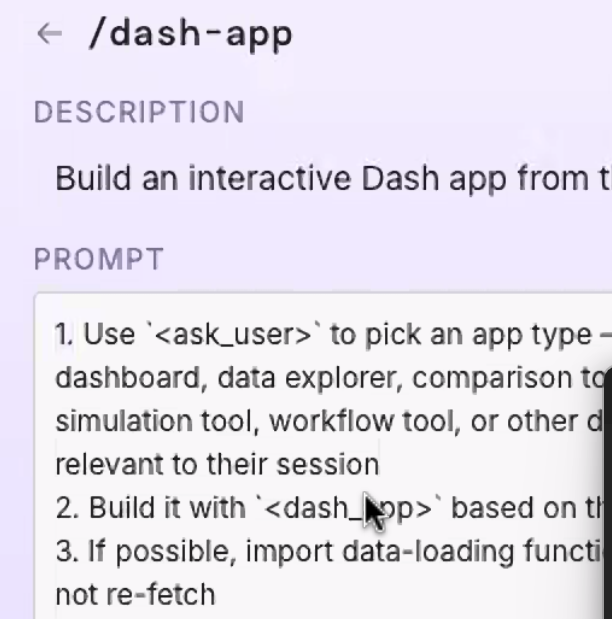
This dramatically lowers the barrier to entry:
- Non-developers can create sophisticated applications
- Developers can accelerate workflows and reduce boilerplate coding
- Iteration becomes as simple as describing desired changes
The result is a more inclusive ecosystem where building data-driven tools is accessible to a broader audience.
From Conversation to Artifacts
A key innovation in Plotly Studio is the ability to transform exploratory conversations into structured outputs, or “artifacts.” These include:
- Interactive charts and tables
- Analytical reports (write-ups)
- Fully functional data applications
The platform captures context from the entire interaction and uses it to generate polished outputs. For example, a series of ad hoc questions can evolve into a comprehensive report complete with visualizations and narrative explanations.
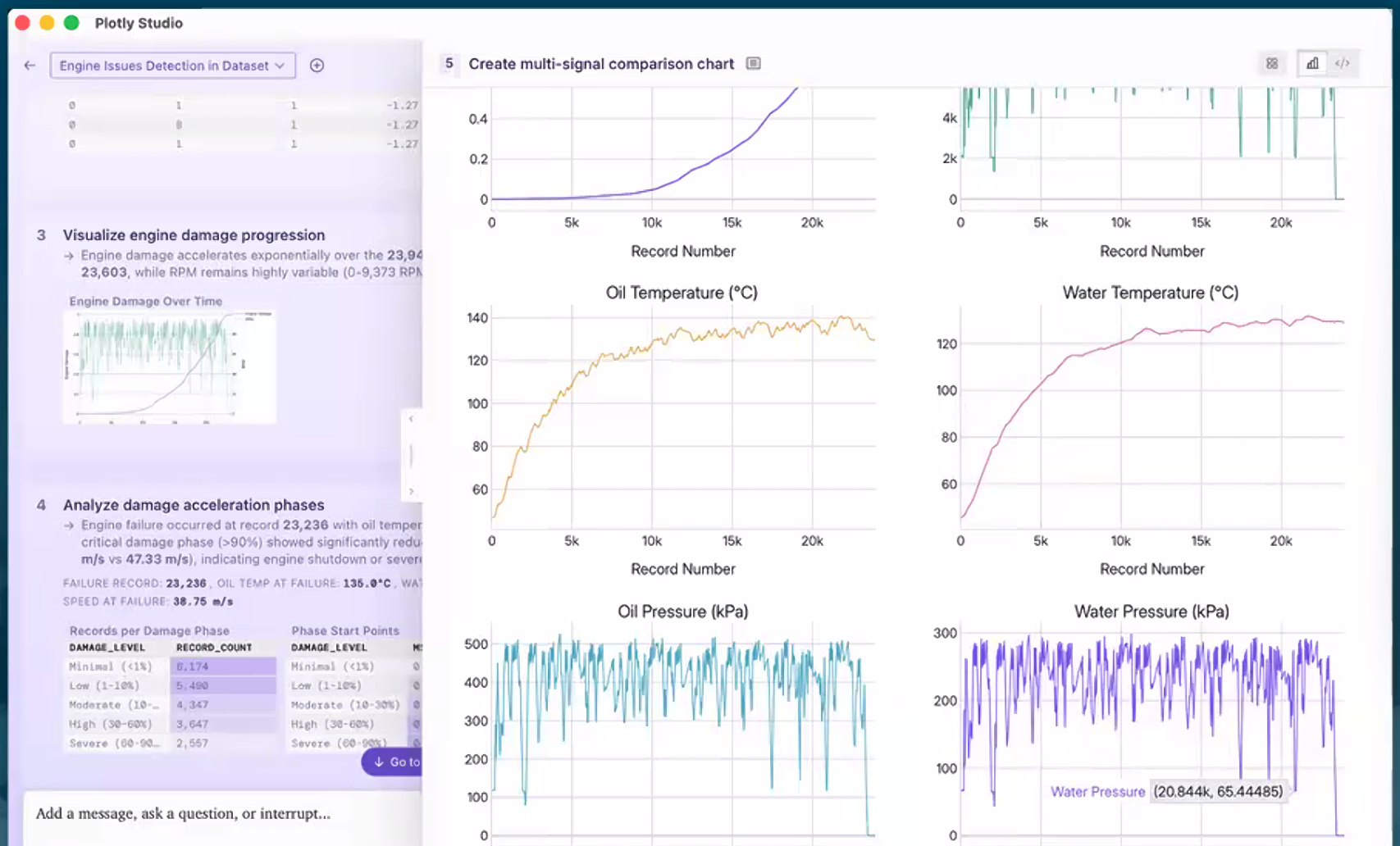
This eliminates the need to recreate analysis in separate tools and ensures continuity between exploration and presentation.
Transparency and Trust in AI Analysis
As AI systems become more integral to analytics, trust and transparency are critical. Plotly Studio addresses this through several design choices:
- All outputs are backed by executable code
- Calculations are performed programmatically, reducing hallucination risk
- Summaries clearly distinguish computed values
- The system highlights assumptions and ambiguities
Importantly, the agent will pause and consult the user when uncertainty arises, rather than making silent assumptions.
Additionally, reports include sections detailing methodology, data sources, and limitations; allowing users to validate and communicate findings with confidence.
Built-In and Custom “Skills”
Agentic Mode introduces reusable capabilities called skills, which act as pre-packaged prompts or workflows. These include:
- Data quality checks
- Automated report generation
- One-click application creation
Users can also create custom skills tailored to their workflows, defining instructions for connecting to data, applying business logic, or enforcing branding standards.
This feature enhances productivity by standardizing repetitive tasks and embedding domain expertise directly into the system.
Seamless Sharing and Deployment
Once analysis artifacts are created, they can be easily shared. Plotly Studio supports one-click publishing to Plotly Cloud or Dash Enterprise, enabling:
- Secure deployment of applications
- Controlled access for team members
- Scalable, production-grade environments
This simplifies collaboration and ensures that insights can be operationalized quickly, without complex deployment pipelines.
Iterative and Conversational Development
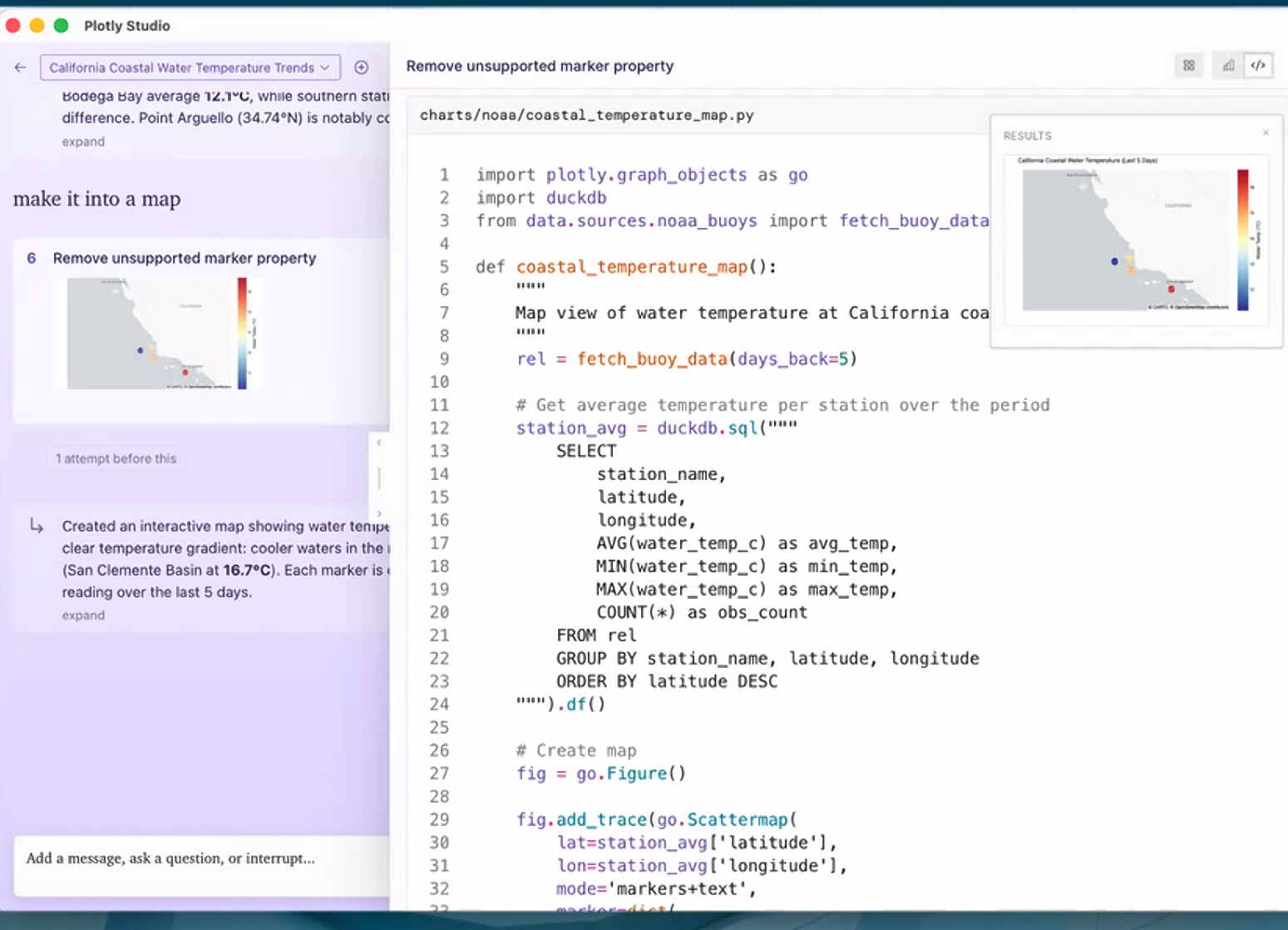
Another defining characteristic is the ability to iterate conversationally. Users can modify existing outputs, such as adjusting an application layout or adding new visualizations, by simply describing changes in natural language.
This creates a feedback loop where:
- The agent generates an artifact
- The user provides guidance
- The agent updates the artifact
Such iterative workflows resemble “vibe coding,” but with a stronger emphasis on data integrity and reproducibility.
Security and Enterprise Readiness
Plotly Studio also addresses enterprise requirements. Features include:
- Secure credential storage (not exposed to the AI model)
- Support for private LLMs and on-prem deployment
- SOC 2 compliance and SSO integration
These capabilities ensure that organizations can adopt agentic analytics while maintaining strict data governance standards.
The Road Ahead: Toward Autonomous Analytics
Looking forward, Plotly plans to extend Agentic Mode with features such as:
1. Project-Based Workflows
Instead of isolated sessions, users will manage analyses within projects that share data connections, artifacts, and version control.
2. Scheduled Autonomous Sessions
The system will be able to run analyses automatically, generate reports, and update applications on a schedule without user intervention.
3. Continuous Collaboration
Teams will be able to collaborate more effectively by sharing data contexts and building upon each other’s work.
These advancements point toward a future where analytics systems operate as persistent, intelligent collaborators, continuously delivering insights.
Conclusion
Plotly Studio’s Agentic Mode represents a significant leap forward in how data work is performed. By combining conversational AI, autonomous execution, and seamless application development, it transforms analytics into a more intuitive, efficient, and collaborative process.
The platform moves beyond dashboards to a new paradigm, where users can simply ask questions, explore data, and deploy solutions in a unified workflow. More broadly, Plotly Studio serves as a strong example of the emerging agentic analytics movement. As one of the leading products helping shape this trend, it demonstrates how AI agents are moving from experimental assistants to practical collaborators in data-driven organizations. In doing so, it democratizes access to powerful analytics and sets the stage for a future where AI agents are central to data-driven decision-making.
By Lesya Berbeka, Quantitative Research and Analytics Lead at Kodershop