Odoo accounting reports turn daily journal entries into structured financial statements that managers can actually use. Instead of waiting for month-end summaries, the finance team can spot trends, track revenue changes, or identify unexpected costs in real time. For example, by reviewing the Profit and Loss report, a company can see immediately if a product line is underperforming or if expenses are growing faster than income.
The system integrates seamlessly with sales, purchasing, inventory, and manufacturing, so financial figures update automatically as transactions are posted. This means the Odoo accounting software provides reliable financial reports, including the Odoo balance sheet, without extra tools or manual adjustments.
A key benefit is that these reports always reflect the current financial position. Unlike static historical summaries, the Odoo balance sheet gives managers a live view of assets, liabilities, and equity, while cash flow statements provide insight into liquidity, allowing them to make informed decisions based on real-time data rather than delayed period-end reports.
Using Odoo Accounting Reports for Strategic
Decisions
In modern ERP environments, accounting reports are no longer passive financial summaries prepared only for compliance. Within the Odoo accounting system, reports are actively used to monitor performance, control risks, and support operational decisions across departments. Odoo accounting reports transform accounting entries into actionable insights by connecting finance with Purchasing, Sales, Inventory, and Projects. This approach reflects the evolution of OpenERP accounting, where the OpenERP accounting module established a unified logic for generating reliable Odoo financial reports directly from business activity.
Analyzing Profits and Expenses
One of the most common use cases for Odoo accounting reports is tracking profitability across products, services, or departments. Using Odoo accounting, companies analyze income statements together with breakdowns to understand margin dynamics and expense behavior. This allows management to identify unprofitable activities early and adjust pricing or cost structures based on real data produced by the Odoo accounting system, for example, evaluating product lines or service departments monthly.
Reading the Odoo Balance Sheet
Businesses rely on the Odoo balance sheet to assess financial stability and long-term solvency. Generated by Odoo accounting software, this report provides a structured view of assets, liabilities, and equity at a given moment. For decision-makers, this supports investment planning, financing discussions, and risk evaluation using consistent accounting logic inherited from OpenERP accounting, such as assessing financial stability before major investments.
Tracking Cash Flow with Odoo Accounting
Cash availability is a critical concern for growing companies, and Odoo accounting reports play a key role in liquidity management. By combining cash flow statements with aging data, Odoo accounting helps finance teams track incoming and outgoing funds and detect payment risk early. These Odoo financial reports support better short-term planning and reduce dependency on external cash tracking tools, for example, by projecting short-term cash requirements for payroll or supplier payments.
Fine-Tuning Budgets with Odoo Accounting
Many organizations use Odoo accounting software to compare planned budgets with actual accounting results. Budget versus actual analysis within Odoo accounting reports allows teams to evaluate planning accuracy and enforce financial discipline. This use case is especially relevant in Odoo Community Accounting, where companies seek strong control mechanisms without complex external reporting systems. By leveraging these reports, managers can quickly identify variances, adjust forecasts, and ensure that departmental spending aligns with strategic objectives.
Preparing for Audits with Odoo Accounting
Compliance and audit preparation remain essential responsibilities of finance teams. Based on the structure of the OpenERP accounting module, Odoo accounting reports provide traceable, auditable financial data for tax reporting and external reviews. These Odoo financial reports improve transparency and reliability while ensuring that accounting processes remain aligned with regulatory requirements. Additionally, they simplify external audits by providing ready-to-use, detailed reports that reduce the risk of errors and improve stakeholder confidence.
Why Analytic Reports in Odoo Accounting Are Essential for Business Insights
Accurate Odoo accounting reports form the backbone of any meaningful analytic reporting in Odoo 19. Without a properly configured Odoo accounting system, data from Sales, Purchases, Projects, and Inventory cannot be aggregated reliably, making Odoo financial reports incomplete or misleading. Analytic accounts, cost centers, and reporting rules defined in Odoo accounting provide the structure needed to generate actionable insights. By establishing a solid accounting foundation first, companies ensure that analytic reports reflect true operational and financial performance, supporting informed decisions, effective budgeting, and real-time tracking of business KPIs.
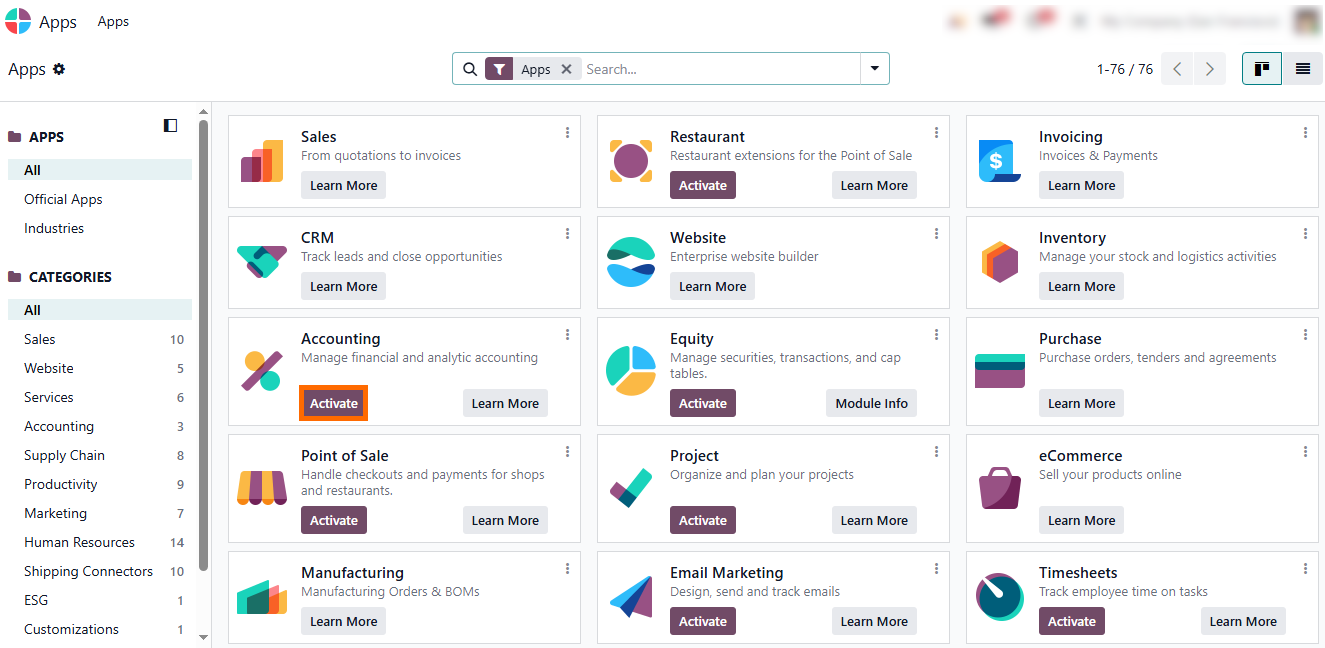
- To
start, install the Accounting application from the Apps menu. This setup
enables the creation of analytic accounts, journals, and reporting hierarchies
necessary for
generating advanced Odoo accounting reports.
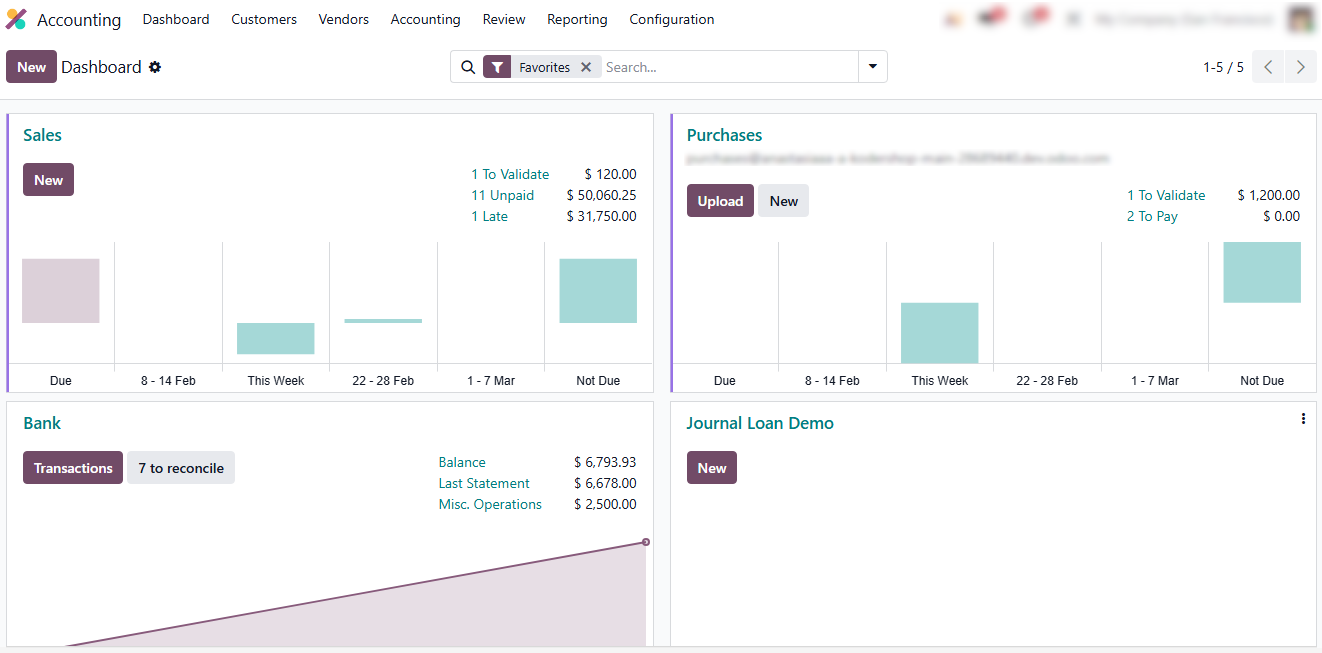
- Once
enabled, Odoo accounting software can
link transactions across products, projects, and departments to analytic
accounts, creating the foundation for accurate
and detailed analytic reporting.
Main Odoo Accounting Reports for Financial Control
Odoo accounting reports can be grouped into strategic financial statements and operational control reports. Together, they form a complete financial view inside the Odoo accounting system, supporting both high-level decision-making and day-to-day financial management. These reports are a core component of Odoo accounting software, helping finance teams track profitability, monitor costs, and ensure compliance using a single financial framework. By combining summary-level insights with detailed transactional data, Odoo accounting transforms posted journal entries into reliable Odoo financial reports, including management views and statutory statements such as the Odoo balance sheet. To keep this guide focused, this section covers only the core Odoo accounting reports used for financial control, performance analysis, and managerial decision-making in Odoo Community Accounting and Enterprise environments.
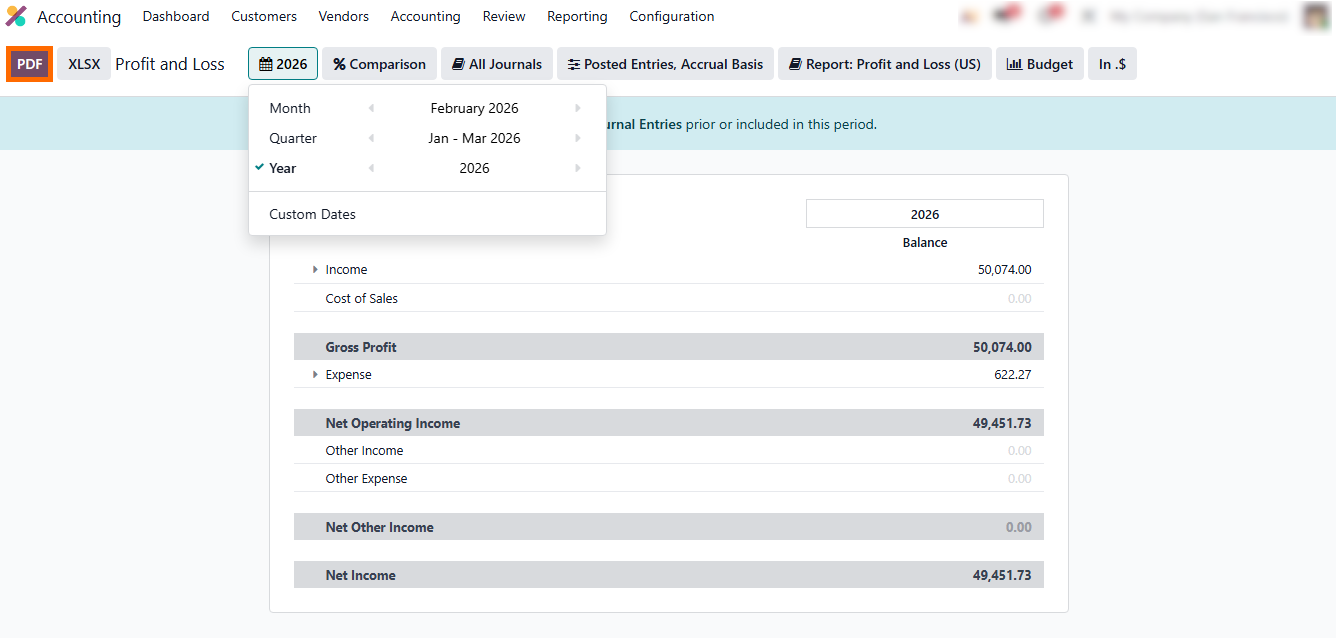
- Click on “Reporting” and select “Profit and Loss” to analyze revenues, costs, and net profit for a selected period, compare performance across months or fiscal years, and evaluate operational efficiency based on real accounting data.

- Select the period, comparison, and key filters, then export the “Profit and Loss” report in PDF or XLSX to share clear Odoo accounting reports across the Odoo accounting system or Odoo Community Accounting environments.
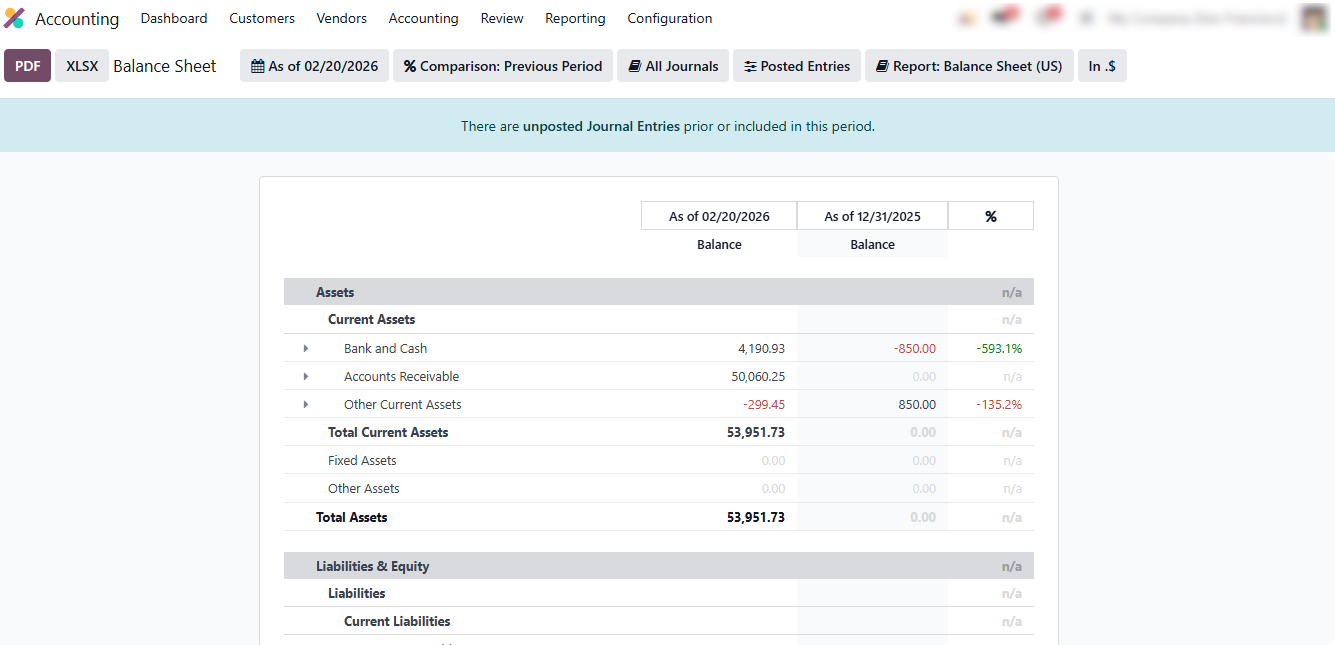
- Select “Balance Sheet” to review assets, liabilities, and equity at a specific date, using the Odoo balance sheet to evaluate the company’s financial position based on real-time data from the Odoo accounting system.
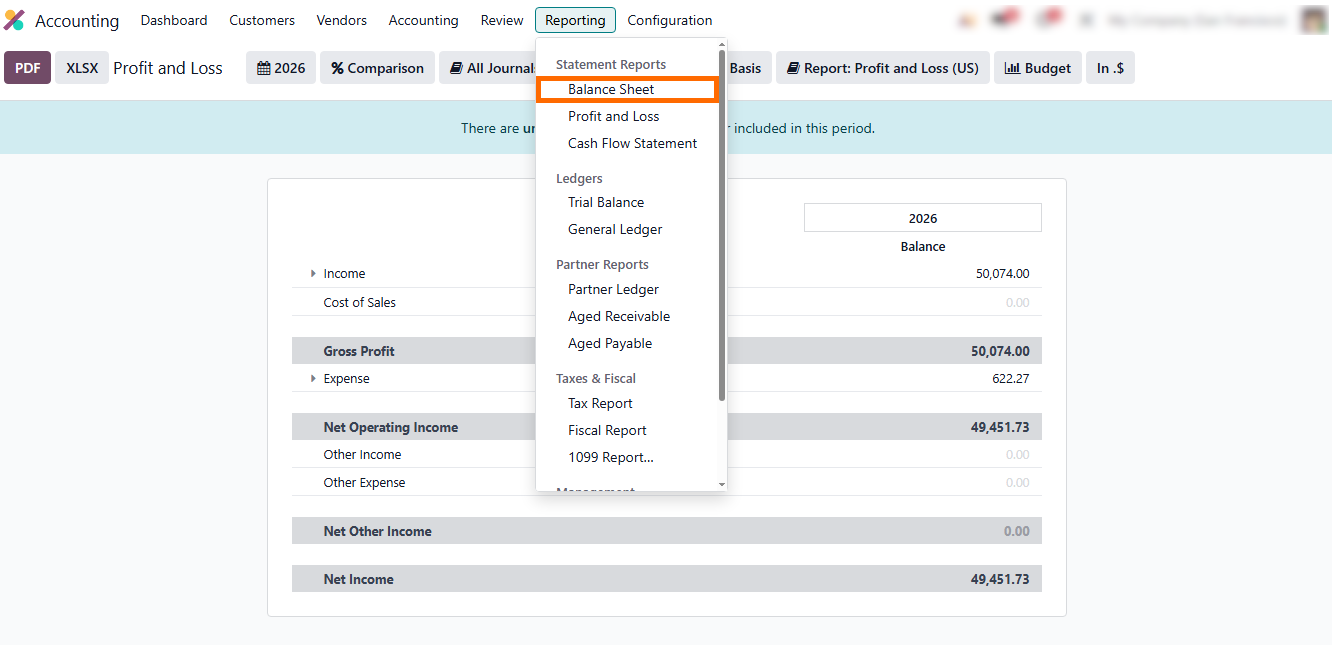
- Adjust the reporting date, comparison period, and key filters to analyze balance sheet dynamics over time and identify structural changes in assets, liabilities, and equity within the Odoo accounting system.
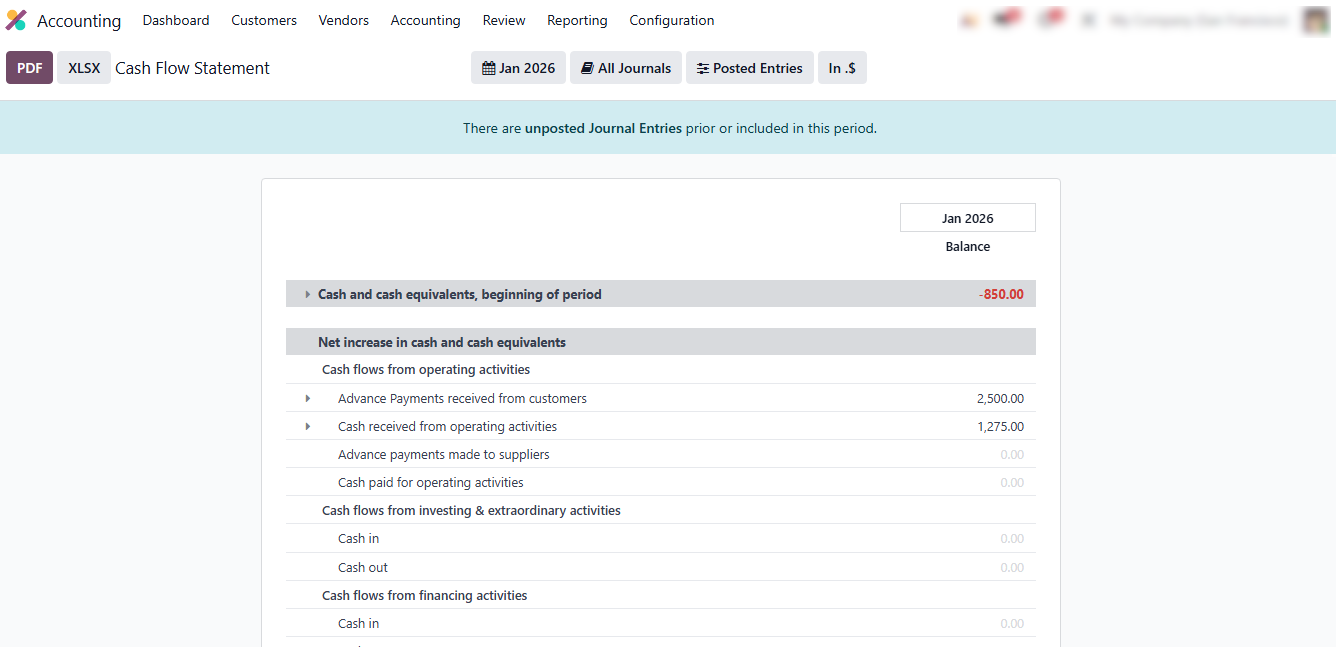
- Select “Cash Flow Statement” to track operating, investing, and
financing cash movements, helping assess liquidity trends and short-term
financial stability based
on real-time data from the Odoo accounting system.
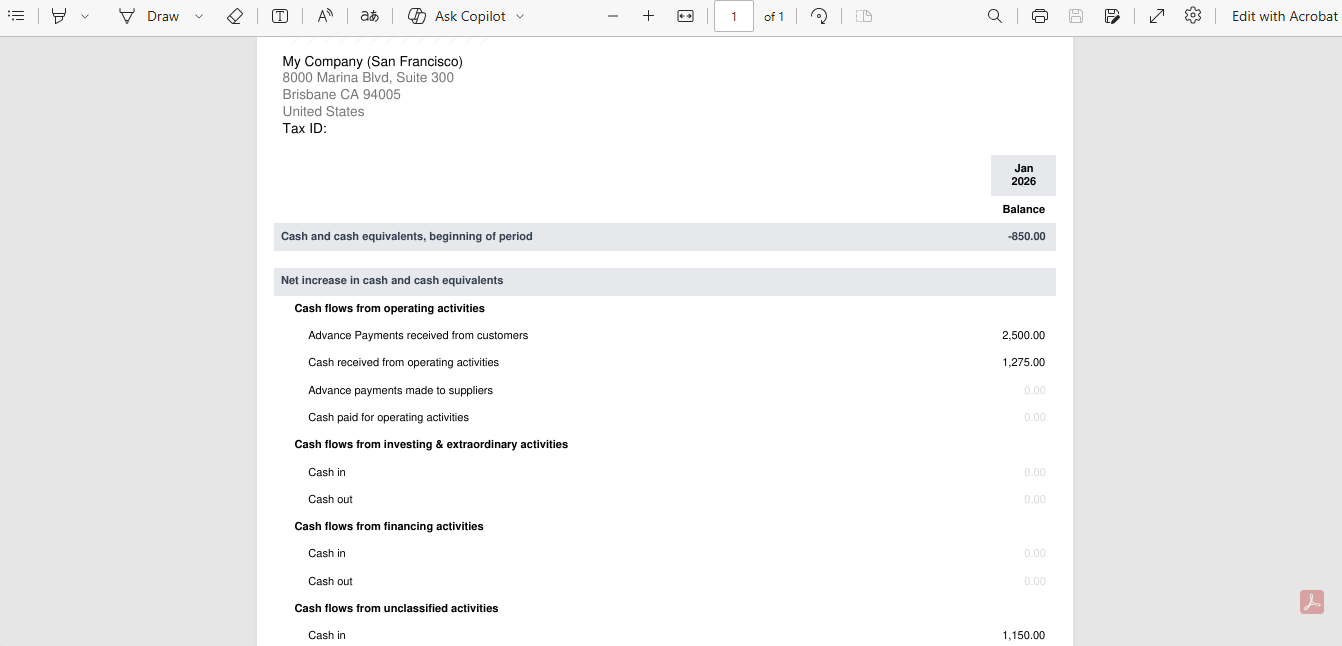
- Set the reporting period to align with the accounting cut-off and review cash movements by activity to understand how operating, investing, and financing flows affect short-term liquidity.
While strategic Odoo financial reports support long-term planning, Odoo accounting reports at the operational level help finance teams monitor day-to-day transactions, validate data accuracy, and detect issues before they affect financial statements. Within the Odoo accounting system, these reports transform posted journal entries into practical control tools used by accountants, controllers, and finance managers. At the core of operational reporting is the tight integration of Odoo accounting with inventory movements, sales orders, purchasing flows, and manufacturing transactions. Because the Odoo accounting software records financial entries in real time, operational Odoo accounting reports always reflect the current state of the business. This makes them essential for validating postings, reconciling balances, and ensuring that operational activity aligns with accounting policies defined in the system.
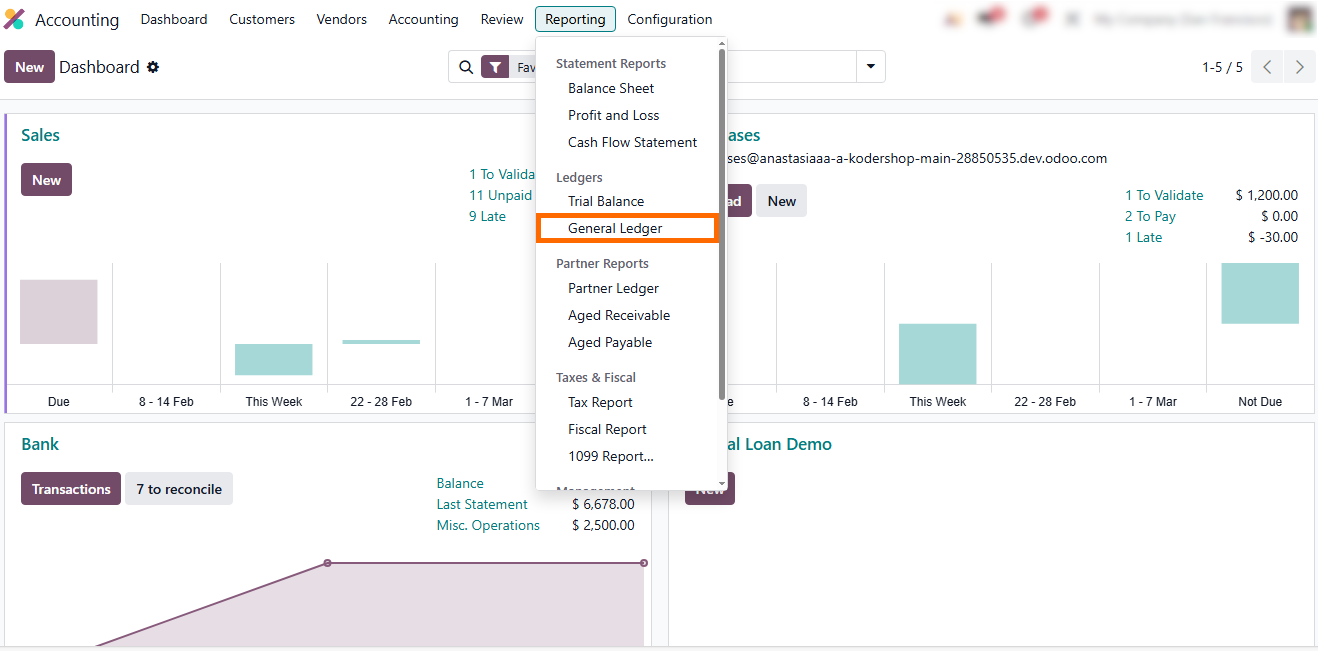
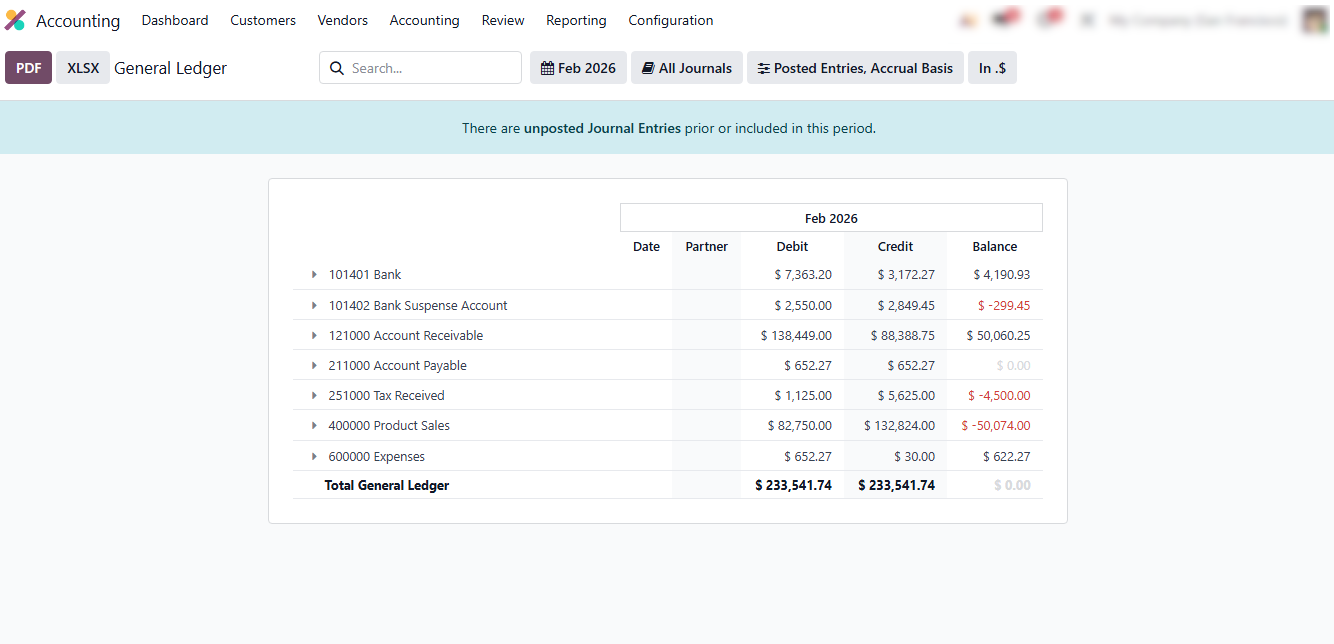
- Open “Reporting” and select “General Ledger” to view all posted journal entries and verify detailed account movements. This allows you to trace every transaction back to its source and confirm accuracy.
- Check for balanced debits and credits, confirm postings against source documents (invoices, orders, stock moves), and validate analytic accounts.
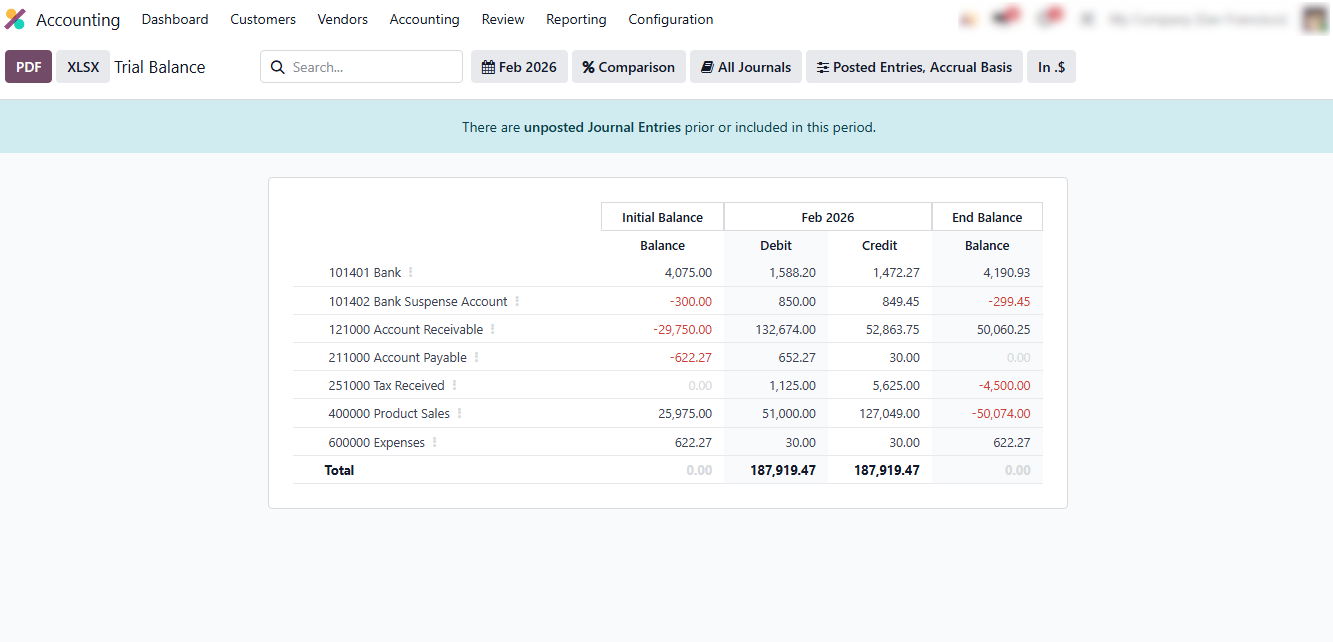
- Next, select “Trial Balance” to quickly review total debits and credits per account and identify discrepancies before they affect financial statements. This step ensures that the books remain balanced and ready for higher-level reporting.
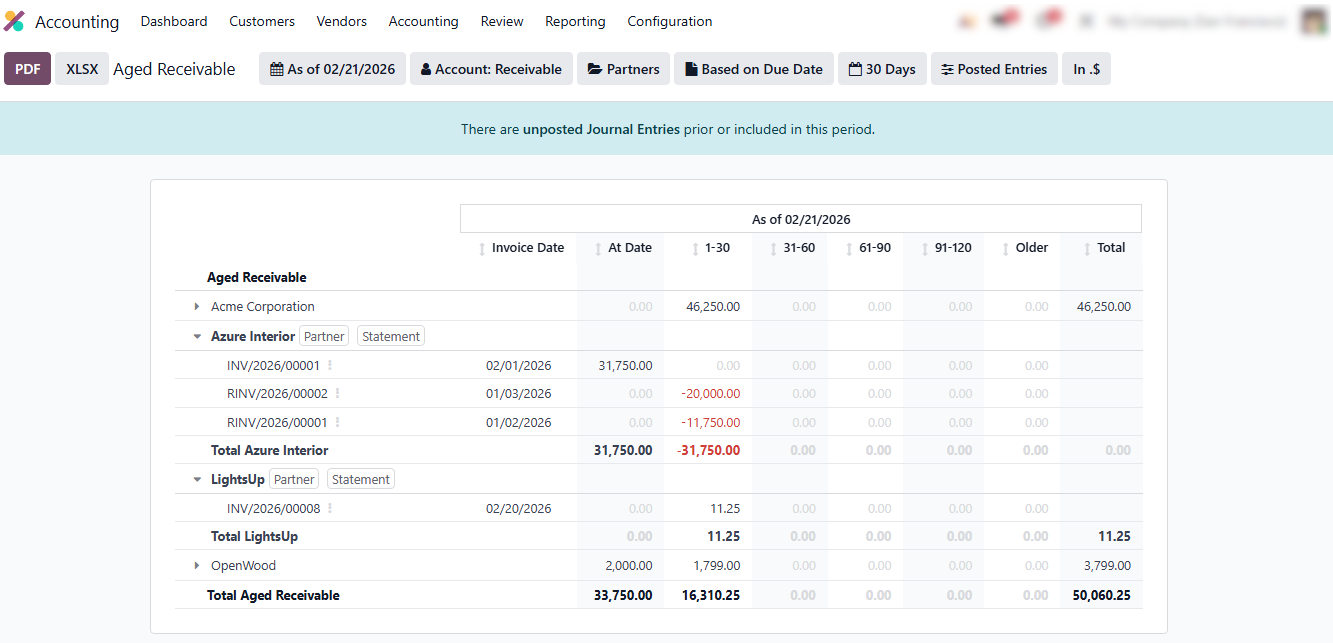
- After that, navigate to “Reporting” and select the “Aged Receivables” report to analyze customer balances and overdue invoices, highlighting collection risks.
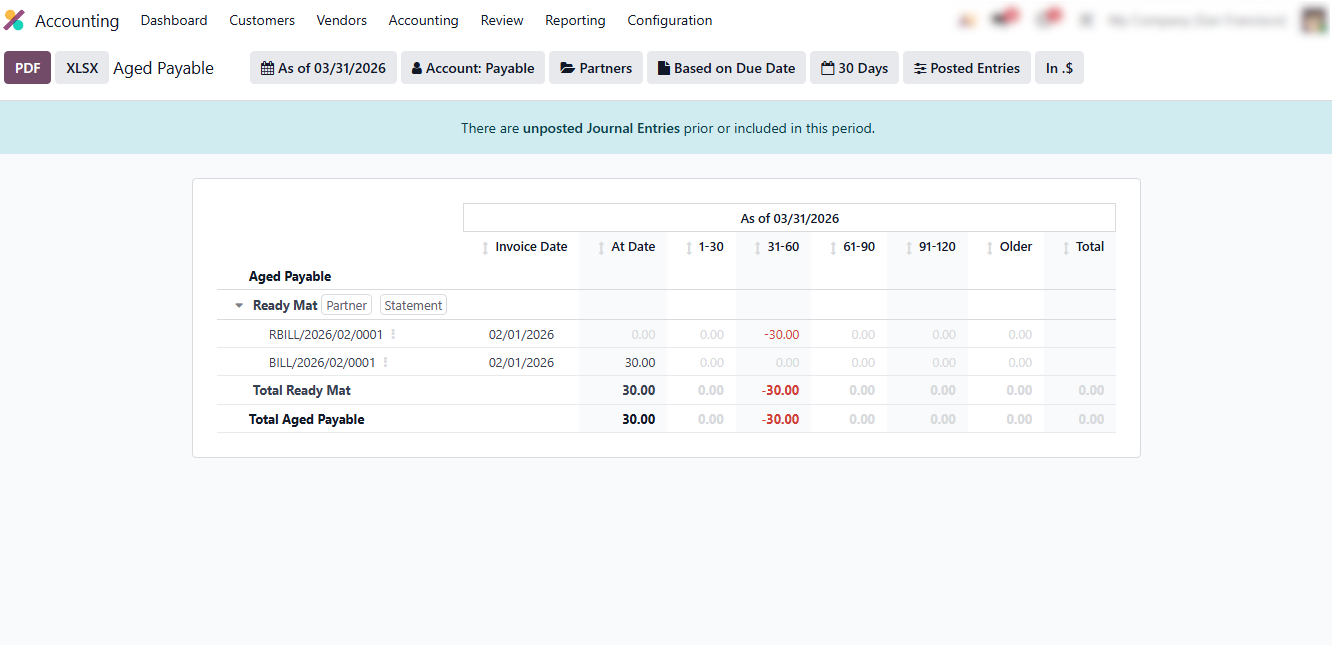
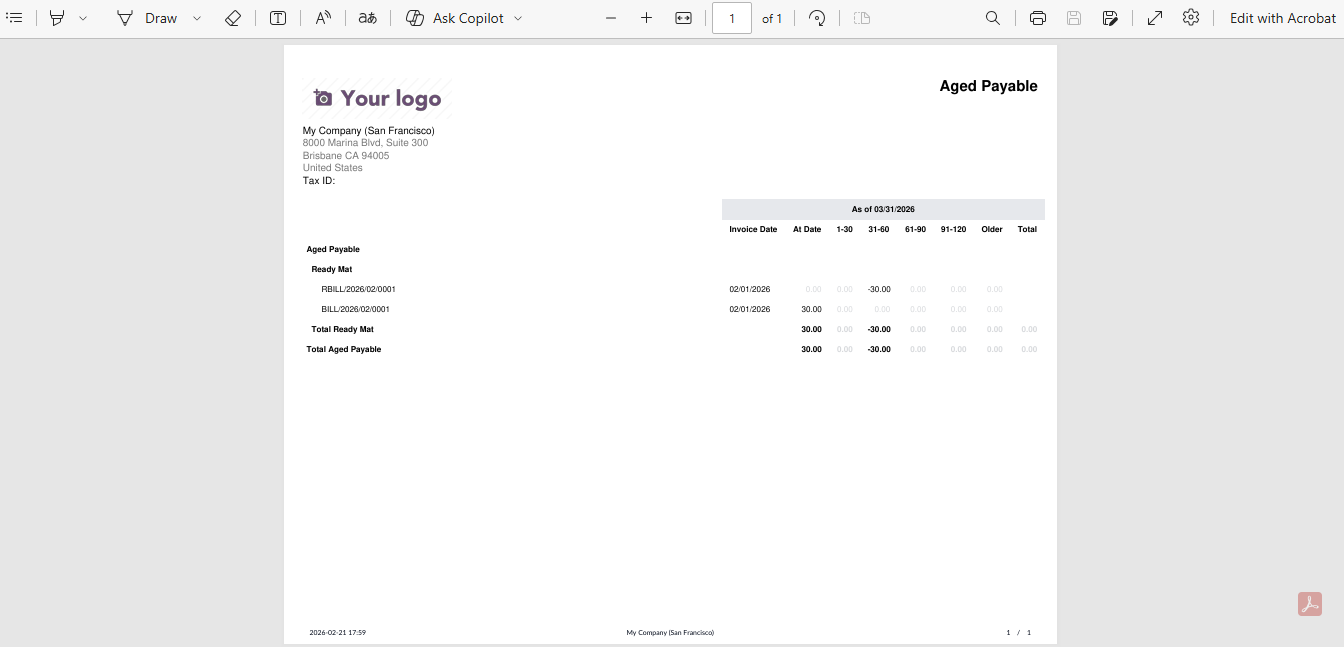
- Select “Reporting” and “Aged Payables” to monitor supplier obligations and upcoming payments, ensuring timely settlements. Use filters such as partner, due date, or invoice status to focus on critical items and proactively manage cash flow.
- Finally, use export
to PDF or XLSX for all operational reports to share insights with finance
teams, controllers, or Odoo Community
Accounting environments. This ensures
transparency and easy distribution of key operational data.
Common Mistakes in Odoo Accounting Reports and How to Avoid Them
Even with a well-configured Odoo accounting system, reporting issues often arise not from missing features but from incorrect setup or inconsistent usage. Many companies rely on Odoo accounting reports for daily control and strategic analysis, yet overlook foundational rules that directly affect data accuracy. Because Odoo accounting software generates reports directly from posted transactions, any structural mistake immediately impacts Odoo financial reports, including management views and the Odoo balance sheet. Understanding these common pitfalls helps organizations maintain reliable reporting across both Enterprise and Odoo Community Accounting setups.
Misconfigured Chart of Accounts and Reporting Structure
One of the most common mistakes in Odoo accounting is using a poorly structured chart of accounts. When accounts are incorrectly grouped or mapped, Odoo accounting reports may show distorted totals, misleading subtotals, or inconsistent balances. This directly affects core Odoo financial reports, especially the Odoo balance sheet, where assets, liabilities, and equity rely on correct account classification. To avoid this issue, companies should review account groups and reporting tags early, ensuring alignment with accounting standards and the reporting logic inherited from OpenERP accounting and the OpenERP accounting module.
Ignoring Analytic Accounts in Odoo Accounting Software
Another frequent issue is relying solely on general ledger data without properly using analytic accounts. While Odoo accounting software can generate standard financial statements, operational insights remain limited without analytics. As a result, Odoo accounting reports may reflect correct totals but fail to explain cost drivers or profitability by project, department, or product line. By consistently applying analytic accounts, businesses improve the depth of Odoo financial reports and ensure that operational performance is accurately reflected within the Odoo accounting system, especially in Odoo Community Accounting, where external BI tools are often avoided.
Mixing Operational and Strategic Reporting Periods
Many reporting inconsistencies occur when operational reviews and strategic analyses use the same reporting periods, without adjustment. For example, using real-time Odoo accounting reports intended for daily control to evaluate long-term performance can lead to incorrect conclusions. This practice often distorts trend analysis and creates confusion around the Odoo balance sheet at period close. In Odoo accounting, operational checks should be performed on a daily or weekly basis, while strategic reporting should rely on clearly defined monthly or quarterly periods to avoid misinterpretation of financial data.
Over-Reliance on Exports Instead of Live Reports
While exporting reports to PDF or XLSX is useful for sharing, relying exclusively on exported files is a common mistake. Static exports quickly become outdated, especially in systems where transactions are posted continuously. This reduces the reliability of Odoo accounting reports and weakens financial control. Using live Odoo financial reports inside Odoo accounting software ensures that finance teams always work with current data, while exports should be treated as snapshots rather than primary control tools.
Using Legacy OpenERP Logic Without Review
Companies upgrading from earlier systems often retain accounting logic based on OpenERP accounting without reassessing its relevance. While the OpenERP accounting module established a strong foundation, modern Odoo accounting introduces additional controls, reporting options, and analytic capabilities. Failing to review legacy setups can limit the effectiveness of Odoo accounting reports and lead to underutilized features within the Odoo accounting system. Periodic audits of configuration and reporting logic help ensure that Odoo accounting software fully supports current business needs.
Conclusion
To get real value from Odoo accounting reports, you need to treat accounting reports as an active management tool rather than a formal output generated at period end. In practice, reliable results come not from complex customization, but from consistent accounting logic, disciplined data entry, and a clear understanding of how the Odoo accounting system processes transactions. Because Odoo accounting software generates reports directly from posted journal entries, the quality of Odoo financial reports always reflects how accurately daily accounting operations are handled.
By separating strategic analysis from operational control, using analytic accounts consistently, and regularly reviewing reports such as the Odoo balance sheet, you maintain clear visibility into financial performance and risks. This approach works equally well in Enterprise setups and Odoo Community Accounting, where internal reporting often replaces external tools.
Built on principles inherited from OpenERP accounting and the OpenERP accounting module, modern Odoo accounting provides a unified reporting framework that connects finance with sales, inventory, purchasing, and manufacturing. When configured and used correctly, Odoo accounting reports move beyond static statements and become a practical foundation for financial control, operational decisions, and confident planning.