For decades, enterprise technology has moved like a pendulum. Periods of consolidation have given way to specialization, only for complexity to force a return to integration.
Now, with the rapid advancement of artificial intelligence (AI), enterprise resource planning (ERP) and human capital management (HCM) are entering another pivotal swing—one that is redefining how organizations think about systems, data, and value.
ERP: From Monolithic Backbone to Intelligent Core
ERP systems emerged in the 1990s as the central nervous system of the enterprise. As integrated platforms designed to manage finance, supply chain, manufacturing, procurement, and HR in a single system of record, early ERP promised efficiency through standardization and control. The cost of rigidity and long implementation cycles, however, was unavoidable.
The cloud era softened these constraints, yet ERP still struggled to keep pace with fast‑changing business needs. As AI adoption accelerated, some questioned whether ERP had become an outdated relic. However, recent research shows the opposite: ERP is becoming more important, not less, as AI scales beyond pilots into enterprise-wide impact. ERP remains the trusted source of structured data, governance, auditability, and process logic that AI depends on to function reliably at scale. [mckinsey.com], [deloitte.com]
Even with the could era, many large organizations still did not opt to implement an ERP and rather opted for a collection of best of bread systems or in certain cases custom-built (home-gown) applications that delivered to their specific requirements. These systems often are very hard to integrate and lead to creating silos of functional systems, processes and data that led to inefficiencies, manual work and the absence of a singular source of truth for the enterprise data. I have faced this same challenge during my career: multiple systems, no clear view of a single source of truth and so many manual processes to achieve enterprise outcomes. In the absence of an ERP and a full scale HCM, we opted to build an orchestrating platform that would enable the organization to integrate multiple systems and processes (HR, Payroll, Finances, Asset Management, Corporate Director), create one source of truth for the enterprise data, generate documents by collecting data from multiple systems, and manage multiple cross-functional workflows. This platform would also create one trusted instance of the employee during the whole employment lifecycle (onboarding, assets, training, certifications, pay, expenses, security profile, delegation of financial authority, and offboarding). At the time, Agentic AI was not where it stands today and this problem would have been solved easily by connecting all different systems with an agentic-ERP-like solution.
By natively embedding Agentic AI, modern ERP is no longer just a transactional system. Analysts increasingly describe its future as “agentic ERP, "with:
- A modular, API-driven core
- AI agents operating alongside human users
- Automating decisions
- Orchestrating workflows
- Real time event responding while preserving enterprise controls.
The Rise—and Cost—of Best‑of‑Breed HCM
While ERP was evolving, HCM followed a different trajectory. As workforce complexity increased, specialized HCM vendors emerged offering deeper functionality in areas such as
- recruitment,
- payroll,
- learning,
- performance management,
- employee experience.
This best‑of‑breed approach delivered rapid innovation and superior user experiences in many HR domains. AI adoption accelerated this trend, enabling capabilities such as predictive attrition modeling, AI-driven recruitment screening, individualized learning paths, and automated payroll compliance.
Industry analyses consistently show that AI has pushed HR from administrative automation toward predictive, outcome‑oriented workforce strategy. [sap.com], [linkedin.com]
However, specialization came with tradeoffs. As organizations layered multiple HCM tools onto ERP financial and operational systems, data fragmentation increased. Maintaining integrations, ensuring data consistency, governing AI outputs, and securing employee data became increasingly complex. Over time, the cost of orchestration—both technical and organizational—began to erode the perceived advantages of best‑of‑breed models.
Again, this is another problem I have run into
when I was running SAP on prem for payroll and running SuccessFactors as the
HRIS, developing an integration between both was very complex and resulted in a
number of challenges due to custom processes and mitigating the integration
shortfalls to ensure data synchronization proved to be very costly.
[www3.techn...uation.com],
[rvnatech.com]
AI as the Great Re‑Integrator
AI has changed the economics of enterprise architecture. While early digital transformation rewarded specialization, AI rewards context.
Models are only as effective as the quality, completeness, and semantic consistency of the data they consume. Disconnected systems weaken this foundation.
Recent
analyst perspectives emphasize that AI relies on ERP not merely as a data
source, but as the structural language of the enterprise—defining entities,
relationships, workflows, and controls that give AI decisions meaning and
accountability.
[mckinsey.com],
[deloitte.com]
This is particularly critical for HCM. Workforce data does not live in isolation; it intersects with
- finance (costs, forecasts),
- operations (capacity, productivity),
- compliance (audit, regulation).
As AI moves from assisting HR tasks to autonomously managing workflows, the risks of misalignment increase when HCM is disconnected from core enterprise processes.
Why Companies Are Returning to ERP‑Centric Models
Increasingly, organizations are reassessing fragmented application landscapes. Rather than abandoning innovation, they are seeking to re‑centralize intelligently—modernizing ERP platforms to natively support advanced HCM and AI capabilities while retaining openness where differentiation truly matters.
Industry reports highlight several drivers behind this shift:
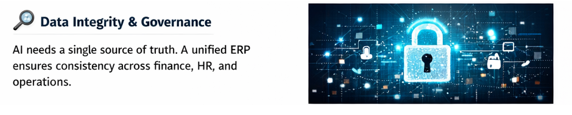
- Data integrity and governance: ERP-centric architectures provide a single source of truth and standardized controls essential for trustworthy AI outcomes.
- Lower integration overhead: Fewer systems reduce dependency on brittle custom integrations that slow AI adoption.
-
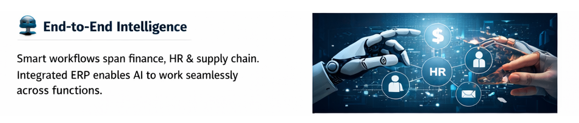
End‑to‑end AI workflows: Intelligent
automation increasingly spans finance, HR, and operations, favoring platforms
that understand the whole process, not just one function.
[deloitte.com],
[erpperspective.com]
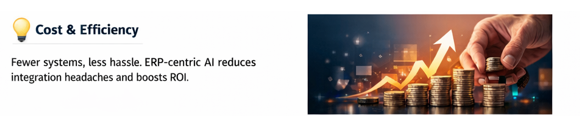
- AI economics: Centralized platforms allow AI investments—models, agents, governance frameworks—to be reused across domains rather than duplicated in every application.
This does not imply a return to the rigid, monolithic ERP of the past. The direction is toward composable ERP cores, where modular services and embedded AI coexist with extensibility and selective specialization. [deloitte.com]
One example of these ERPs is Odoo, an open-source modular ERP where Apps are available for downloading and integration is already pre-built hence eliminating any integration work required. In Odoo everything is an App that can be downloaded by itself with clear dependencies between these Apps (i.e. you need the Employee App to run the Payroll App…).
HCM’s Future: Embedded, Intelligent, and Strategic
In this new model, HCM is not disappearing,—it is evolving. Rather than standing apart as a separate ecosystem, HCM capabilities are increasingly embedded into ERP platforms, powered by the same AI engines and data foundations that drive the rest of the enterprise.
Research on AI-driven HCM shows that value increasingly comes from cross-functional intelligence: aligning workforce planning with financial forecasts, linking skills development to business strategy, and integrating employee experience with operational outcomes. [sap.com], [erp.today]
ERP vendors and enterprise architects are responding by rethinking HCM as a strategic layer within the enterprise core, supporting human‑in‑the‑loop AI, ethical governance, and enterprise-wide insight.
The Road Ahead
The future is not a rejection of best‑of‑breed nor a nostalgic return to legacy ERP. Instead, AI is forcing a higher standard: enterprises need systems that balance innovation with coherence, autonomy with control, and intelligence with trust.
As AI becomes embedded into everyday decision‑making, the organizations that succeed will be those that anchor intelligence in a strong, integrated enterprise core—using ERP as the foundation on which modern HCM and AI capabilities can safely, scalably, and strategically thrive.
The
future? Unified, intelligent, ERP-driven
The pendulum has swung again—but this time, it is guided by intelligence, not just integration, by outcomes not just efficiency, and by instant insight, not just data.
By: Hatem Belhi, Head of Payroll Product with Kodershop Software with a career in HCM, HR and Payroll outsourcing and shared services spanning over 22 years spent in large organizations such as the Government of Ontario, City of Toronto, Manulife and ADP.
A note from Hatem: This article was inspired by the MIT Professional Education Leadership for the AI Age Driving Digital Transformation for Competitive Advantage course I attended few months ago. One of the course components was to develop a digital transformation project leveraging AI. My chosen subject was automating Payroll and Payroll adjacent processes from beginning to end levering Robotic Process Automation (RPA), Agentic AI and Generative AI. This work led me to ponder further on how to rethink enterprise processes altogether from functionally driven to outcome based which subsequently led me to explore the future of enabling technologies (i.e. ERPs and HCMs) in the age of AI.