Every customer order has a journey. Can you see all of it?
Imagine it's Monday morning.
One of your sales reps has just called with good news.
"The customer accepted the quote."
Everyone celebrates. Another order in the books.
But for the business, that's not the finish line. It's the starting point.
That single order is about to pass through sales, engineering, purchasing, production, quality, shipping, and finance. Every department needs the right information at the right time to keep things moving.
If one team is working from outdated data, if a supplier misses a delivery, or if production priorities change without everyone knowing, the entire order can slow down.
The customer doesn't see those internal handoffs. They only see whether the product arrives when you promised.
A typical manufacturing order might look like this:
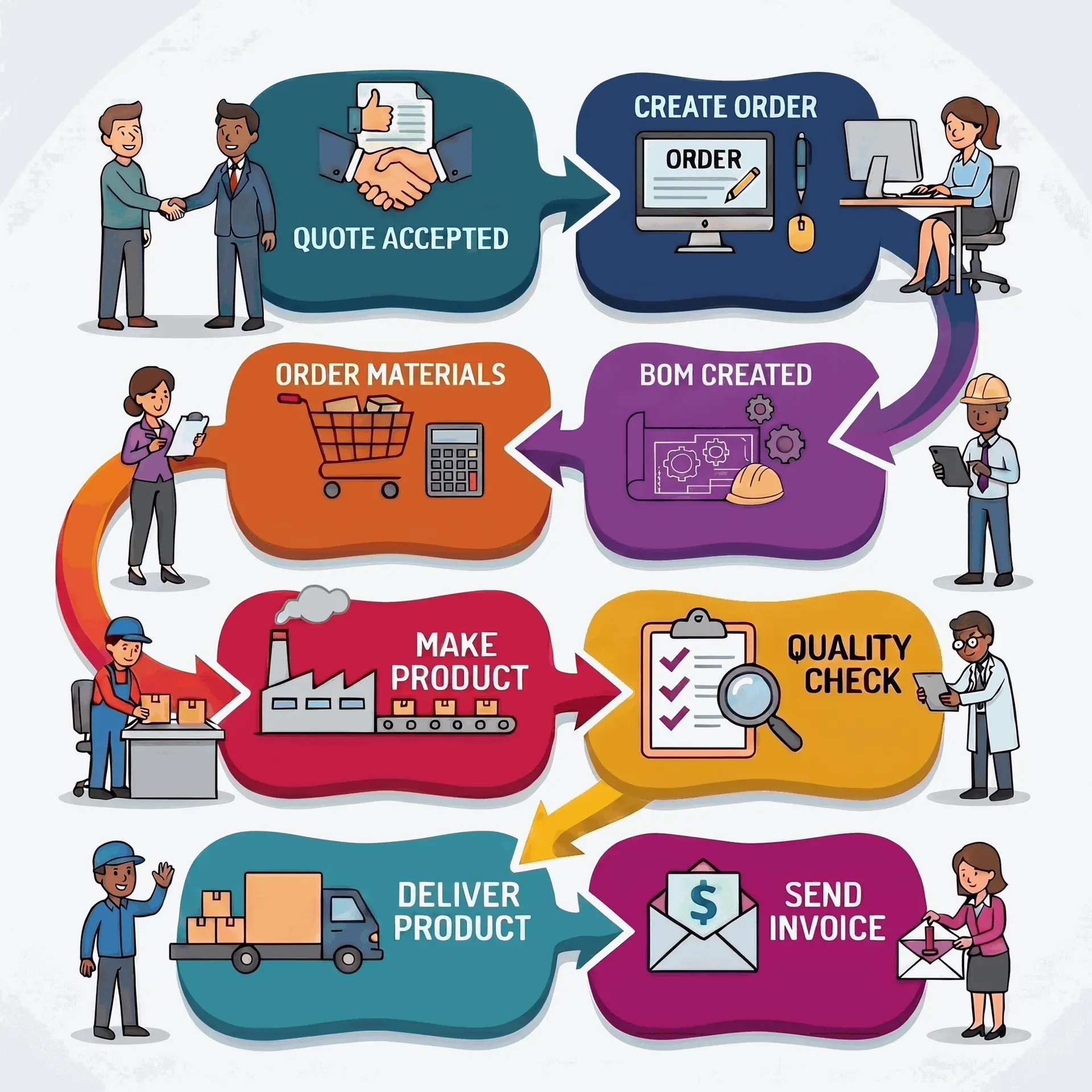
Every handoff transfers more than the order itself. It transfers delivery commitments, engineering revisions, inventory requirements, production priorities, quality records, shipping schedules, and eventually financial data. When those handoffs happen manually or across disconnected systems, a shared view of the order starts to disappear.
Every step depends on the previous one being accurate, up to date, and visible to everyone involved.
One missing piece of information can ripple through the entire process.
Industry Insight 1: Boeing's production recovery
A good example comes from Boeing's ongoing effort to stabilize production of the 737 MAX.
Following heightened regulatory scrutiny, the company shifted its focus from increasing output to improving quality and operational transparency across its production processes. According to Reuters, Boeing has introduced cross-functional reviews of safety reports and is even using machine learning to identify potential supplier quality issues before they become widespread. Rather than simply building faster, the company recognized that better insight into production and supplier performance was essential to improving reliability and restoring customer confidence.
The lesson applies well beyond aerospace: when operations become more connected, problems can often be identified before they become costly delays.
Where Things Go Wrong
Most manufacturers don't lose operational awareness all at once.
It disappears gradually.
- Sales promises a delivery date without seeing current production capacity.
- Purchasing doesn't know engineering has revised the bill of materials.
- Production reschedules a job but customer service still has the original completion date.
- Shipping dispatches the order, but finance doesn't invoice until days later.
No single department has done anything wrong. None of these delays seem significant in isolation. But together they create a chain reaction:
Production waits for materials
↓
Shipping dates slip
↓
Customer expectations become harder to manage
↓
Payment is delayed.
The business isn't suffering from one large failure, it's losing momentum through dozens of small disconnects.
The problem is that everyone sees a different version of the same order.
Industry Insight 2: New FDA regulations make visibility a business requirement
The U.S. Food and Drug Administration's Food Traceability Rule require businesses across parts of the food supply chain to maintain detailed records that make products easier to trace throughout their journey. While aimed at improving food safety, the regulation reflects a broader industry trend: manufacturers are expected to have accurate, connected data that can follow products across suppliers, production, and distribution. Researchers examining the rule noted that the biggest challenge is ensuring information remains connected and usable throughout the supply chain.
Whether you're manufacturing food, industrial equipment, or custom products, customers and regulators increasingly expect that same level of traceability and operational transparency.
Operational Awareness ≠ Reports
Traditional reports are valuable for measuring performance after the fact. Operational awareness is different. It helps people make better decisions while work is still in progress, when there's still time to prevent delays rather than simply explain them later.
Try to answer these questions as quickly as possible:
- Can we actually deliver this order on time?
- Which customer orders are waiting for materials?
- Which jobs are at risk of missing their production window?
- Has the customer already been invoiced?
- Where is cash currently tied up in the process?
If answering those questions means opening several spreadsheets or sending a handful of emails, you don't have a reporting problem. You have a information flow problem.
Industry Insight 3: Boeing tariffs highlight the importance of connected operations
In 2025, manufacturers across multiple industries faced renewed uncertainty around tariffs and component availability. Boeing was closely monitoring the impact of tariffs on supplier parts availability, even while its internal production performance was improving. The challenge wasn't simply sourcing components but rather understanding how supplier disruptions could affect production schedules, deliveries, and ultimately cash flow.
This is increasingly common across manufacturing. External disruptions can't always be prevented, but organizations with connected operational data are generally better positioned to understand where orders are affected, communicate with customers sooner, and adjust plans before small issues become major delays.
Confidence Comes From...
The goal isn't to watch every order every minute.
It's to know, with confidence, that everyone is working from the same information.
- Sales knows what production can realistically deliver.
- Purchasing understands what demand is coming.
- Production has live inventory and material availability.
- Finance knows exactly when products have shipped and invoices can be sent.
Leadership can see where orders are progressing, and where they're getting stuck, without waiting for a weekly meeting.
When every department shares the same operational picture, decisions become faster, customers receive more accurate updates, and cash moves through the business more efficiently.
Confidence comes from a connected quote-to-cash process.
Closing
A customer saying "yes" to your quote is exciting.
But it isn't what determines whether the order is profitable.
What matters is everything that happens afterwards.
The manufacturers that consistently deliver on time aren't immune to supply chain disruptions, engineering changes, or shifting customer priorities. They simply have better insight into how those changes affect the entire journey from quote to cash.
When the sales rep announces, "The customer accepted the quote," that shouldn't create uncertainty about what comes next. Every department should already have the information they need to move the order forward with confidence.
Because at the end of the day, you can't deliver what you can't see.
Works Cited
Catchpole, D. (2025). Boeing increases 737 production pace as quality, safety culture improves. Reuters. https://www.reuters.com/business/autos-transportation/boeing-increases-737-production-pace-quality-safety-culture-improves-2025-05-21/
Reuters. (2025). Boeing CFO flags worries around tariff impact to parts availability. Investing.com. https://www.investing.com/news/stock-market-news/boeing-cfo-flags-worries-around-tariff-impact-to-parts-availability-3937097
Kwon, S., Wieczorek, C., Biggs, H., Suttles, S., Etheridge, T. S., Rothschild, A., & Bardzell, S. (2026). The new era of tech-enabled traceability: Tensions between the FDA's data governance vision and the lived realities of food producers. arXiv. https://arxiv.org/abs/2606.18593