Over the past several years, global supply chains have been forced into continuous adaptation. From pandemic-related shutdowns to geopolitical instability and shipping constraints, manufacturers have had to rethink how they source, produce, and deliver goods.
Research from organizations such as McKinsey & Company and World Economic Forum suggests that supply chain volatility is now structurally higher than in previous decades. This means disruption should no longer be considered anomalies, but rather part of the operating environment.
But as conditions stabilize in some areas, manufacturers face a new challenge:
Which
changes should remain permanent, and what should be rolled back?
1. Nearshoring: Keep Strategic Proximity, Not Blanket Relocation
During global disruption periods, many companies shifted production closer to end markets to reduce risk exposure from long, fragile supply chains.
Apple has progressively expanded manufacturing and assembly operations in countries like India and Vietnam to reduce reliance on a single geography.
- India now plays a growing role in iPhone assembly
- Vietnam is increasingly important for AirPods and MacBook production
This shift was accelerated by COVID-19
disruptions and geopolitical tensions affecting China-based production.
The Lesson
Nearshoring is not about replacing global supply chains, it is about reducing concentration risk.
✔ What to keep
- Regional diversification of critical production steps
- Dual-region sourcing strategies for key components
- Geographic risk mapping in supply chain design
✖ What to avoid
- Fully duplicating entire supply chains without cost/complexity analysis
- Moving production without understanding downstream capacity constraints
Key insight: Resilience comes from balance,
not relocation.
2. Supplier Diversification: Keep Redundancy, Avoid Fragmentation
Many organizations rapidly expanded their supplier base to reduce dependency on single-source risk.
Example: Toyota’s multi-sourcingstrategy
Toyota Motor Corporation has long maintained a structured supplier diversification model, including secondary and tertiary suppliers for critical components. This approach helped the company recover faster than many competitors after the 2011 earthquake and tsunami in Japan, which severely disrupted automotive supply chains.
Rather than relying on a single supplier per part, Toyota’s network design allowed production to be rerouted when disruptions occurred.
The Lesson
Supplier diversification only creates resilience when it is structured—not when it is reactive.
✔ What to keep
- Approved secondary suppliers for critical components
- Formal supplier qualification processes
- Supplier risk scoring and monitoring
✖ What to avoid
- Excessive supplier sprawl that increases coordination complexity
- Fragmented purchasing decisions across departments
Key insight: More suppliers do not automatically equal more resilience; better structured suppliers do.
3. Inventory Strategy: Keep Buffers, Replace Blanket Stockpiling
During global disruptions, many manufacturers increased inventory levels broadly to avoid stockouts. While this solved short-term shortages, it also created long-term inefficiencies, higher carrying costs, reduced cash flow flexibility, and excess stock in low-variability categories.
Schneider Electric provides a strong manufacturing example of how inventory strategy evolved from reactive buffering to data-driven segmentation and planning.
Schneider Electric has publicly documented its transition toward a digitally integrated supply chain, where:
- Inventory decisions are driven by real-time demand signals
- Safety stock is adjusted dynamically based on risk and volatility
- Supply chain planning is integrated across production, procurement, and logistics systems
- Advanced analytics and control towers are used to improve responsiveness
This shift was part of its broader “end-to-end supply chain digitization” strategy, aimed at improving resilience while maintaining efficiency.
The Lesson
Schneider Electric’s approach highlights a key evolution in modern manufacturing supply chains:
✔ What to keep
- Segmented inventory strategies (critical vs. non-critical SKUs)
- Dynamic safety stock models based on demand volatility
- Integrated planning systems linking demand, production, and procurement
- Real-time visibility into inventory positions across the network
✖ What to leave behind
- One-size-fits-all inventory increases
- Static reorder points disconnected from demand shifts
- Spreadsheet-driven stock decisions
- Overreliance on “just-in-case” inventory across all categories
Key insight: The most resilient manufacturers don’t “hold more inventory,” they hold smarter inventory.
In Schneider Electric’s case, digital integration allowed the company to reduce guesswork in inventory planning and replace it with data-driven, scenario-aware decision-making.
4. Data Visibility: Keep Real-Time Decision-Making Systems, Not Static Reporting
One of the most consistent failure points during recent supply chain disruptions: internal visibility.
Manufacturers often discovered they could not reliably answer basic operational questions in real time:
- What is actually in stock across all locations?
- Which production jobs are delayed or blocked?
- How do supplier delays impact customer delivery dates?
To avoid systems problems caused by disconnected spreadsheets, manual updates, and fragmented ERP usage, companies benefit from shifting toward real-time, integrated operational systems where supply chain, production, inventory, and financial data are unified.
Chemtex Global provides a clear example of how fragmented supply chain management breaks down under scale, and how integrated ERP systems restore control.
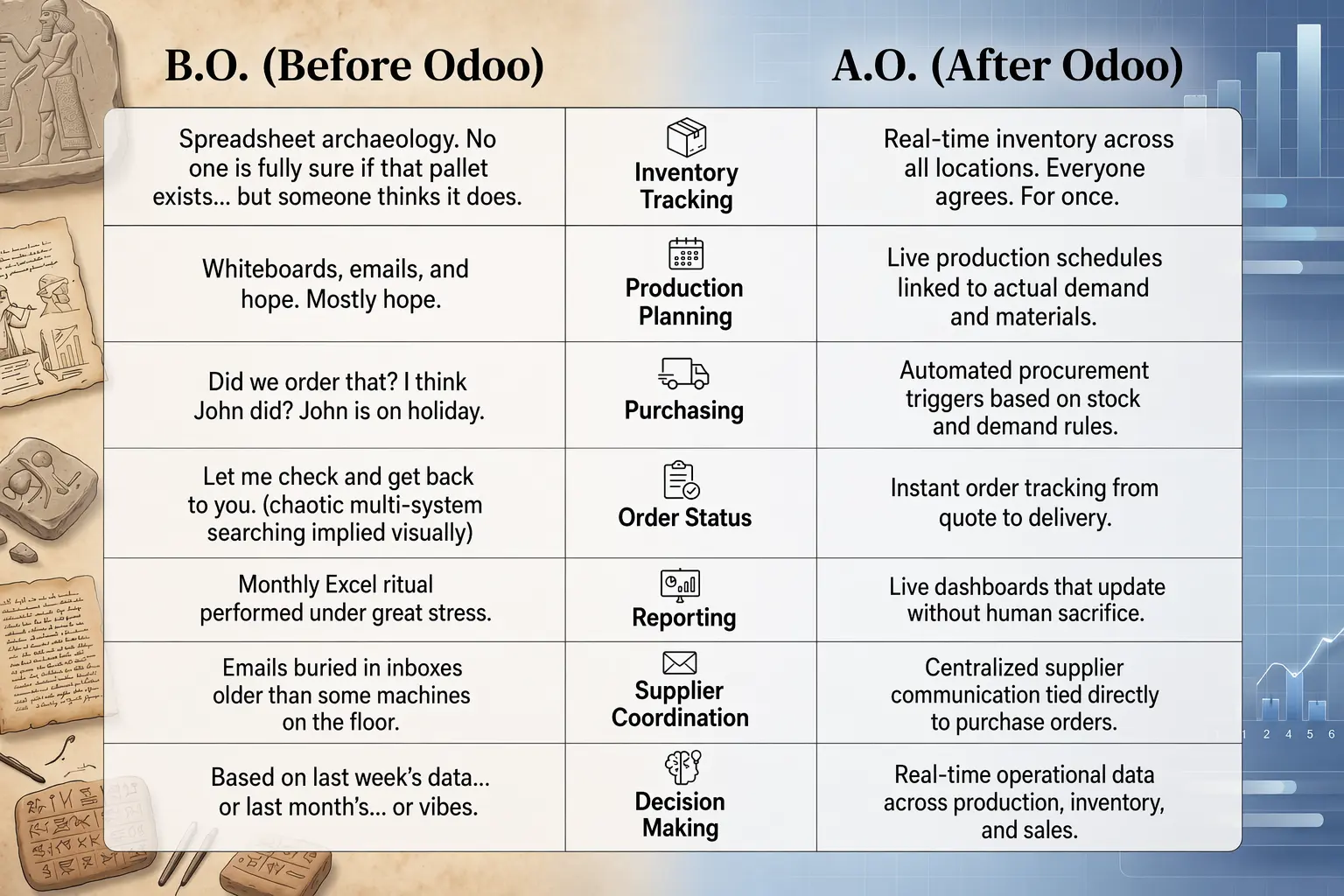
Before implementing Odoo, Chemtex managed inventory across multiple locations, creating inefficiencies in inventory accuracy and operational coordination across regions. After implementing Odoo, Chemtex centralized.
The result was a shift from manual reporting cycles to real-time visibility of inventory and operations, enabling faster coordination and reducing reconciliation time significantly.
The Lesson
Visibility is operational intelligence.
✔ What to keep
- Real-time inventory tracking
- Integrated supplier and logistics data
- End-to-end production visibility
✖ What to avoid
- Spreadsheet-based reporting cycles
- Departmental data silos
- Delayed monthly performance reporting
Key insight: The speed of information now determines the speed of recovery.
5. Planning Models: Keep Scenario Planning, Replace Linear Forecasting
Linear forecasting models failed under volatile demand and supply conditions.
Unilever implemented scenario-based planning approaches to adapt to rapid shifts in demand patterns during COVID-19. The company used multiple demand and supply scenarios rather than relying on a single forecast model.
This allowed faster adaptation to spikes in hygiene product demand and shifts in consumer behavior.
The Lesson
Forecasting is preparing for multiple possible futures.
✔ What to keep
- Scenario-based planning models
- Demand variability simulation
- Flexible production planning
✖ What to avoid
- Single-line forecasts treated as certainty
- Static annual planning assumptions
Key insight: Resilient manufacturers plan for uncertainty, not certainty.
Final takeaway
Across industries, the lesson from recent disruptions is not that supply chains failed—but that many were not designed for variability.
The manufacturers who are emerging stronger are those who have:
- Kept structural resilience improvements (visibility, redundancy, scenario planning)
- Removed reactive overcorrections (excess inventory, fragmented supplier sprawl)
- Invested in integrated systems that unify planning, production, and procurement
In practice, this increasingly means moving away from disconnected tools and toward integrated operational platforms that provide a single source of truth across the supply chain.
Because the defining characteristic of modern manufacturing is ultimately: resilience under uncertainty.