Early detection of illness in livestock has always been a challenge. On most farms, identifying sickness still depends on periodic visual checks by farm staff. While effective in many cases, this approach is limited. Observations happen at specific moments in time; conditions can change quickly, and early symptoms are often subtle enough to be missed.
But what if continuous video monitoring could change that?
Modern livestock environments are already generating large amounts of video data every day. Cameras capture animals as they move, eat, rest, and interact. Until recently, much of this footage was only used for basic monitoring or security. Today, it can serve a much more powerful purpose.
Our team has been developing a framework that uses daily surveillance video to identify early signs of sickness in cattle. By combining computer vision with a clinically validated veterinary scoring system, we are turning raw video into meaningful health insights that can support earlier and more consistent decision-making.
Why Early Detection Is So Difficult
Bovine Respiratory Disease, often referred to as BRD, is one of the most common and costly health issues in cattle, particularly in young calves. Detecting it early can make a significant difference in treatment outcomes and overall herd health.
The challenge is that early symptoms are easy to overlook. These can include:
- Slight nasal discharge
- Mild eye irritation
- Small changes in ear position
- Occasional coughing
- Subtle differences in breathing
Individually, these signs may not raise concern. Together, they can indicate the beginning of illness.
Traditional observation methods face a few key limitations:
- They are not continuous
- They depend on human judgement
- They can vary from person to person
- They are difficult to scale across large herds
This often means that illness is only detected once symptoms become more obvious.
Turning Everyday Video into Useful Data
Video offers a different approach. Instead of relying on occasional checks, it allows animals to be observed continuously throughout the day.
However, videos on their own are not enough. To be useful, they need to be processed and structured so that patterns can be identified and understood.
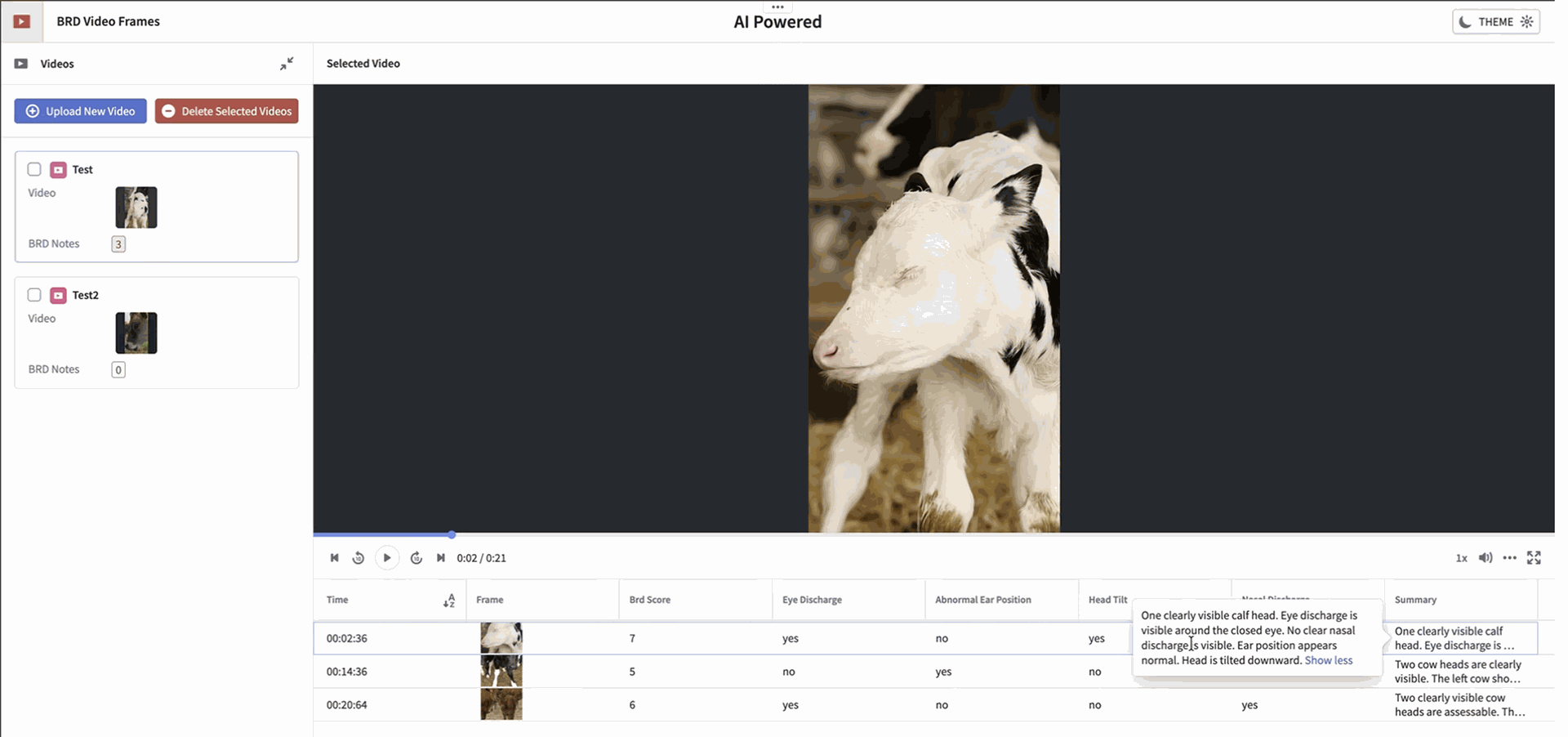
Our framework is designed to do exactly that. It transforms raw footage into organized data that can be analyzed, labeled, and linked to real health indicators.
How the Framework Works
The system follows a series of steps that convert video into actionable insight.
- Continuous Video Capture: Cameras record cattle throughout the day, capturing natural behaviour during feeding, resting, and movement.
- Breaking Video into Segments: Rather than analyzing entire videos at once, footage is divided into smaller time segments. This makes it easier to focus on meaningful moments.
- Extracting Key Frames: From each segment, individual frames are selected at a steady rate, typically one to two frames per second. This keeps the data manageable while preserving important visual details.
- Detecting Visual Features: Computer vision models analyze each frame to identify features linked to health conditions.
- Applying Clinical Labels: These detected features are then translated into clinical indicators using an established veterinary framework.
Each step builds on the previous one, turning unstructured video into something that can support real decisions.
Using a Trusted Veterinary Standard
A key part of this work is ensuring that what the system detects actually reflects real health conditions.
To do this, we use the UC Davis Bovine Respiratory Disease scoring system, a widely recognized method for identifying respiratory illness in young cattle.
This system looks at six clinical signs:
- Eye discharge
- Nasal discharge
- Ear droop or head tilt
- Cough
- Breathing pattern
- Temperature
Each sign is assigned a score depending on whether it is normal or abnormal. For example:
- Eye discharge adds 2 points if present
- Nasal discharge adds 4 points
- Ear droop or head tilt adds 5 points
- Cough adds 2 points if spontaneous
- Breathing adds 2 points if rapid or difficult
- Temperature adds 2 points if above 102.5 degrees Fahrenheit
When the total score reaches 5 or more, the animal may be considered at risk of BRD.
This scoring system is supported by research and is already used in real farm settings, which makes it a strong foundation for video-based detection.
What the System Looks For
Many of the signs used in BRD scoring are visible and can be detected through video.
For example:
- Eye discharge appears as moisture or staining around the eyes
- Nasal discharge shows as visible secretions
- Ear droop can be seen through changes in ear position
- Head tilt affects overall posture
- Cough may appear as sudden repeated movements
- Breathing issues can be observed through increased movement along the animal’s side
Temperature is not visible in video, but it can be added from other data sources.
By connecting these visible features to clinical definitions, the system ensures that its outputs are meaningful and not just patterns without context.
From Observations to Health Scores
Once features are detected, the system begins to build a clearer picture of each animal’s condition.
- Frame-Level Analysis: Each image is analyzed individually, producing predictions with confidence levels.
- Combining Results Over Time: Results are grouped across short time periods to improve reliability and reduce noise.
- Building Animal Profiles: Observations are then combined to create a health profile for each animal.
- Calculating BRD Scores: Detected signs are converted into a total score using the UC Davis system. This allows the system to flag animals that may need attention.
This step is where raw data becomes actionable insight.
The Role of Human Expertise
Even with strong models, human input remains important.
The framework includes a review process where trained staff or veterinarians can:
- Check model predictions
- Correct errors
- Add additional context
Because every frame is linked to its original video and timestamp, reviewers can clearly see what the system is detecting.
This combination of automation and human oversight helps maintain accuracy and trust.
Why This Approach Makes a Difference
Bringing together continuous monitoring, computer vision, and clinical scoring creates several advantages.
- Earlier Detection: Subtle signs can be identified sooner, allowing for quicker intervention.
- More Consistent Assessments: Using a standardized scoring system reduces differences between observers.
- Scalable Monitoring: Large herds can be monitored without needing significantly more labour.
- Clear Evidence: Each assessment is backed by visual data, making it easier to review and validate.
- Better Animal Outcomes: Earlier and more reliable detection supports better treatment and care.
Building for Scale and Reliability
To make this system practical in real environments, several design choices are important:
- Sampling frames at a steady rate to manage data volume
- Keeping detailed timestamps for traceability
- Organizing data by video and segment for efficient processing
- Separating each step of the pipeline to keep it flexible
- Using efficient tools for large-scale video processing
These decisions ensure that the system can grow while remaining reliable and easy to manage.
Looking Ahead
This work represents a shift in how animal health can be managed. Instead of relying only on periodic checks, farms can move toward continuous, data-driven monitoring.
Future improvements may include:
- Expanding detection to other diseases
- Improving model accuracy with more training data
- Adding real-time alerts
- Integrating with farm management systems
The goal is not just better technology, but better outcomes.
By turning everyday video into meaningful insight, it becomes possible to detect illness earlier, act faster, and support healthier herds.